
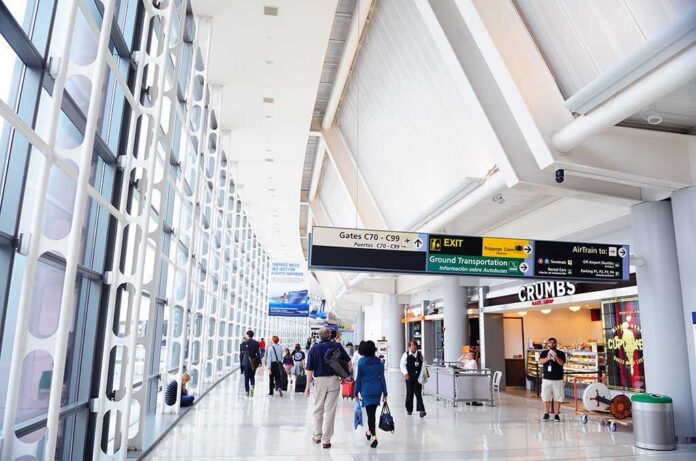
Florida lawmakers just moved to slap President Trump’s name on a major international airport—setting off a familiar fight over local control, taxpayer costs, and whether politics should dominate public infrastructure.
Quick Take
- Florida’s House and Senate passed companion bills to rename Palm Beach International Airport as “President Donald J. Trump International Airport.”
- The change is not final: Gov. Ron DeSantis must sign the measure, and federal approval from the FAA is still required.
- Democrats objected on process and price, citing an estimated $5 million rebranding cost and arguing locals weren’t consulted.
- Supporters argue the airport’s proximity to Mar-a-Lago makes the honor fitting and politically significant during Trump’s presidency.
What the Florida Legislature Approved—and What Still Has to Happen
Florida lawmakers advanced a plan to rename Palm Beach International Airport (PBI) in West Palm Beach as “President Donald J. Trump International Airport.” The Legislature passed companion measures—House Bill 919 and Senate Bill 706—pushing the proposal through both chambers in the same window of reporting. The bill would adjust existing Florida law governing airport names and would provide funding to Palm Beach County tied to rebranding. Final action now depends on Gov. Ron DeSantis and required federal approvals.
Gov. DeSantis’ office signaled the decision is pending: a spokeswoman said the governor had not yet received the bill but would review it in its final form. Even after a signature, the renaming process is not purely symbolic; airport naming intersects with federal aviation systems, which is why the Federal Aviation Administration is cited as a necessary step. Reporting also referenced outreach for comment to Transportation Secretary Sean Duffy’s office, with no response noted.
Why Palm Beach International Is Politically Unique
PBI’s location makes this proposal different from many routine namings: it sits near President Trump’s Mar-a-Lago residence. That proximity has turned a standard infrastructure naming debate into something more like a referendum on the Trump era itself—especially in 2026, with the Biden administration out and voters still sorting through the aftershocks of inflation, border failures, and top-down governance that frustrated much of the country. Florida Republicans are treating the name as a direct tribute tied to place.
The proposal also fits a broader pattern of Trump-related namings referenced in the same reporting, including mentions of highways and a “Trump-Kennedy Center.” In Washington’s orbit, a separate federal idea has circulated to rename the Washington-area Dulles Airport after Trump and Reagan. The point is not that these proposals are identical, but that the political climate is increasingly willing to use prominent public facilities as cultural signals—something voters should understand clearly before costs and precedent become permanent.
Cost, Local Input, and the “Sitting President” Argument
Democratic critics focused less on aviation operations and more on governance. Rep. Lois Frankel, whose district includes the airport area, criticized the process as misguided and argued that local input was ignored. Democrats also cited an estimated rebranding cost of roughly $5 million and raised questions about whether the Trump family could benefit indirectly—though the reporting framed that profit concern as a political warning rather than a documented outcome. Another objection centered on tradition: some argued major facilities should not be named for sitting presidents.
From a conservative, limited-government perspective, the strongest fact-based critique here is procedural rather than partisan: when state lawmakers rename a major local asset, transparency and local participation matter because counties and travelers live with the consequences. The reporting indicates Palm Beach County would be involved in rebranding and that funding is part of the legislation, which puts taxpayer stewardship front and center. Where the public record remains thin is on detailed cost breakdowns and measurable local consultation.
Supporters’ Case and the Next Pressure Points for DeSantis and the FAA
Supporters framed the renaming as an honor that “has a great ring to it,” in the words attributed to White House Communications Director Steven Cheung. Politically, Florida’s GOP majority made passage possible even as Democrats objected on timing and expense. The next pressure points are straightforward: DeSantis can sign, veto, or seek changes, and the FAA’s role means the timeline is not fully controlled by Tallahassee. Those steps will determine whether this becomes a headline—or an actual change on the terminal.
Florida Legislature Approves Plan to Rename Palm Beach Airport After President Trump.
Hopefully all the Liberals will stop using this Airport now and stop coming to Florida.
WINNING! pic.twitter.com/J6FCyh5Lv0
— The Way Forward**Breaking News Daily (@Emperorhanger) February 21, 2026
For voters who are tired of left-wing priorities dominating public life, this fight is also a reminder that symbolism cuts both ways: the same political machinery used for “woke” branding can be used for conservative tributes. The durable question is whether officials can keep the focus on lawful process, accountable spending, and local buy-in while the national press predictably turns it into another cultural brawl. Until DeSantis acts and federal approvals are clarified, the rename remains proposed, not completed.
Sources:
President Donald J. Trump International Airport poised to come to Palm Beach under new bill