U.S. Navy’s blockade of Iranian ports in the Strait of Hormuz delivers a crushing blow to Iran’s war machine, restoring American strength after years of weak diplomacy.
Story Snapshot
- President Trump announced the blockade via Truth Social, effective 10:00 a.m. ET on April 13, 2026, targeting Iranian vessels after failed peace talks.
- Partial blockade allows non-Iranian traffic, focusing on Arabian Gulf, Gulf of Oman, and Arabian Sea ports amid ongoing U.S.-Iran war.
- Iran condemns action as “illegal piracy,” threatens retaliation against all Gulf ports; U.K. declines participation but issues advisory.
- Trump claims Iran’s navy obliterated with 158 ships sunk, emphasizing U.S. naval superiority and energy security.
Trump Orders Decisive Naval Action
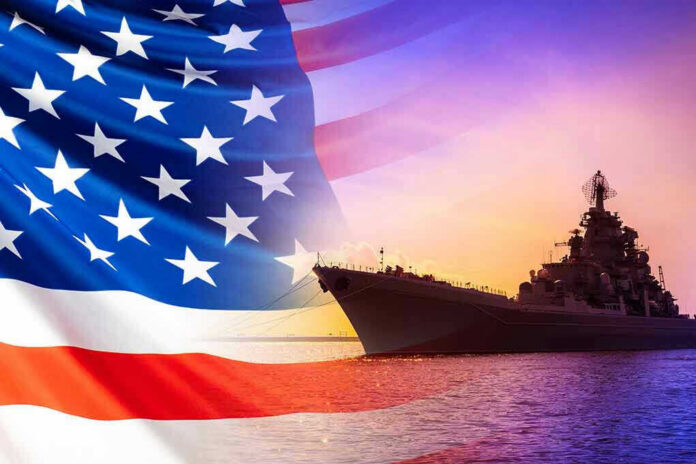
President Donald J. Trump directed the U.S. Navy to impose a blockade on Iranian ports at 10:00 a.m. ET on April 13, 2026. He announced the move shortly after midnight via Truth Social, following collapsed peace talks in Islamabad over the April 11-12 weekend. U.S. Central Command confirmed restrictions apply to vessels entering or exiting Iranian facilities in the Arabian Gulf, Gulf of Oman, and Arabian Sea. Non-Iranian port traffic remains permitted, distinguishing this as a targeted partial blockade of the Strait of Hormuz. This action counters Iran’s control over the vital chokepoint, reduced to a fraction of normal passages since war began.
Failed Diplomacy Paves Way for Blockade
Pakistan-mediated talks between U.S., Iran, and Pakistani negotiators ended without agreement, prompting Trump’s escalation. Iran had impeded Gulf shipping, using strait control as leverage in the ongoing conflict. U.S. forces now enforce rules to restore navigation freedom, echoing 1980s tanker war precedents but with claimed naval dominance. Trump followed up post-10 a.m., stating Iran’s navy lies “completely obliterated – 158 ships” at the sea bottom, excluding fast attack craft. This asserts American military superiority after prior engagements where Iran sank or threatened vessels.
Iran Threatens Retaliation as Allies Hesitate
Iran’s Khatam Al-Anbiya Central Command labeled the blockade “illegal piracy” and warned no Gulf port would remain safe. U.K. Prime Minister Sir Keir Starmer declined military involvement, prioritizing a 40-nation NATO-led coalition to protect strait navigation. UK Maritime Trade Operations issued an advisory enforcing restrictions on all flags engaging Iranian facilities. Pakistan monitors responses post-mediation failure. Power dynamics favor U.S. naval strength against Iran’s threats and regional alliances, amid active war hostilities.
U.S. frames the blockade as lawful enforcement to protect global shipping and energy flows. Iran’s response risks broader escalation, isolating its ports and exports. Gulf states like Saudi Arabia and Kuwait face threats, while shippers and oil markets brace for disruptions.
Energy and Economic Risks Mount
Short-term surges in oil and shipping fears accompany restricted Iranian exports, with potential retaliation heightening war risks. Long-term, full strait closure could trigger global energy crisis, disrupting oil, fertilizer, and goods vital to world trade. Coastal communities and sectors face trade interruptions; fertilizer shortages loom. Political pressure builds on allies as NATO coalition eyes expanded operations. Both conservatives and liberals share frustration with endless foreign entanglements draining resources from American families pursuing the dream through hard work.
Frustrations cross party lines: conservatives decry past globalist weaknesses allowing Iran’s rise; liberals worry over escalating divides and elite-driven wars. This blockade spotlights government priorities favoring power over people, departing from founding principles of limited intervention and individual liberty. Americans demand leaders tackle domestic crises over distant conflicts.
Sources:
CBS News live updates on Iran war, U.S.-Iran ports blockade, Strait of Hormuz, Trump