
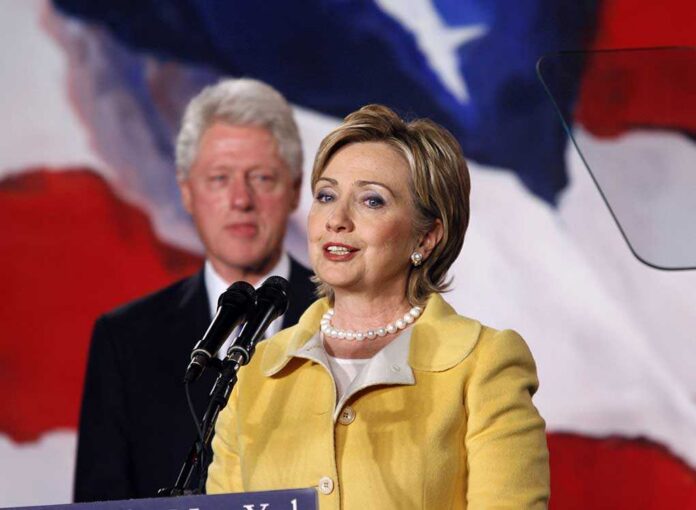
A single panel in Munich showed how fast “women’s rights” turns from a policy fight into a proxy war over reality itself.
Quick Take
- Hillary Clinton moderated a Munich Security Conference panel on February 14, 2026, about global pushback against girls’ and women’s rights.
- Rep. Sarah McBride, the first openly transgender member of Congress, appeared as a featured speaker and was introduced positively as a “gender rights champion.”
- Official congressional travel was disrupted by a partial U.S. government shutdown, but McBride attended independently, according to her office.
- Conservative media framed McBride’s inclusion as hypocrisy and an erasure of sex-based protections; neutral reporting treated it as a standard rights-and-security discussion.
The Munich panel that became an American culture-war accelerant
The Munich Security Conference billed the session as “Girls Just Want to Have Fundamental Rights: Fighting the Global Pushback,” a title that sounds like human-rights boilerplate until you remember where it took place: a premier global security forum. Clinton moderated, and Rep. Sarah McBride joined other panelists to discuss coordinated efforts to roll back protections, from violence prevention frameworks to reproductive policy. Within hours, the event landed back home as a viral outrage cycle.
The facts of the event stay relatively stable across accounts: date, venue, panel title, and participants. The interpretation does not. One strand of coverage emphasized the panel’s argument that authoritarian politics often weaponize gender issues as part of broader instability and disinformation campaigns. Another strand zeroed in on one point only: McBride’s transgender identity, presented as the whole story. That narrowing move matters because it turns a complex topic into a loyalty test.
What Clinton and McBride actually represented on that stage
Clinton’s presence carried decades of branding built on a simple, durable line from 1995: “Women’s rights are human rights.” McBride’s presence carried a different symbol: a history-making election in 2024 as the first openly transgender member of Congress, plus a legislative portfolio that includes bills touching reproductive access and medical privacy. Put them together and you get an unavoidable message: the Democratic coalition now treats transgender inclusion as part of its women’s-rights posture.
That message landed during an awkward Washington moment. A partial government shutdown disrupted official congressional travel tied to DHS funding negotiations, yet McBride still appeared in Munich, with her office confirming she attended independently. For older American readers, that detail rings like a political Rorschach test: either a committed advocate showing up anyway, or a politician chasing a global stage while Congress is in turmoil. The logistics became fuel for narrative, not substance.
Why the outrage framing works, even when the underlying story is thin
The conservative critique did not claim the panel never happened; it argued the panel’s premise collapses when a transgender woman speaks under the banner of women’s rights. That argument resonates because it taps two instincts common in American conservative thought: language should track objective reality, and policy categories must stay legible to protect the vulnerable. If “woman” becomes purely self-declared, sex-based safeguards feel negotiable, and trust in institutions erodes.
Progressive coverage made the opposite bet. It treated McBride’s biography as evidence of credibility: someone who has faced threats and hostility can speak with moral urgency about political pushback and violence. That approach can persuade sympathetic audiences, but it often dodges the central conservative concern: not whether McBride has suffered, but whether redefining sex categories creates downstream confusion in law, sports, prisons, shelters, and medical research. The panel format did not force that confrontation.
The global-security angle most Americans miss
Munich is not a campus teach-in; it is where nations talk about power. The panel’s organizers and speakers linked women’s rights to state stability, arguing that coordinated rollbacks often travel through networks of think tanks, parties, and international narratives, including Russian-influenced messaging. Another panelist, tied to war-crime prosecution and human-rights funding ecosystems, emphasized how sexual violence and intimidation function strategically in conflict. That framing tries to elevate the topic from morality play to national interest.
Americans over 40 have seen this movie before: social issues get drafted into geopolitical messaging, and the public gets handed a simplified villain. The right sometimes reduces it to “globalists exporting ideology,” the left to “authoritarians exporting hate.” Common sense says both can be partially true. Foreign actors exploit social fracture because it is cheap and effective, and domestic activists also use international stages to launder talking points into “consensus.” Munich offered a perfect amplifier.
What a conservative, reality-based critique would demand next
A serious conservative response does not need name-calling or tabloid phrasing. It needs a clear set of questions that policymakers must answer out loud. What legal definition of “woman” governs sex-based protections? Which safeguards remain anchored in biology, and which shift to identity? How do privacy, safety, and fairness get enforced when categories blur? If Clinton’s brand rests on protecting women, voters have a right to hear the practical policy logic, not just applause lines.
OUTRAGE! Hillary Clinton Hosts Panel on “Fundamental Rights For Women” – and Her First Guest is a Man Pretending to be a Woman: Trans Rep. “Sarah” McBride (VIDEO) https://t.co/vn2iSYd7nn
— The Gateway Pundit (@gatewaypundit) February 14, 2026
The larger takeaway from Munich is not that one panel “proved” anything. It showed how modern politics operates: symbols outrun specifics, and institutions struggle to speak plainly. Clinton and McBride offered a coherent progressive message about rights under pressure. Conservative critics offered a visceral objection about definitions and consequences. The public still lacks the missing middle: a rules-based debate that protects women’s safety and dignity without pretending basic categories are optional.
Sources:
Transgender lawmaker Sarah McBride joins Hillary Clinton at girls’ rights forum
Delaware’s Sarah McBride makes history at the DNC after winning congressional primary
Meet Sarah McBride, the First Openly Transgender Person Elected to Congress