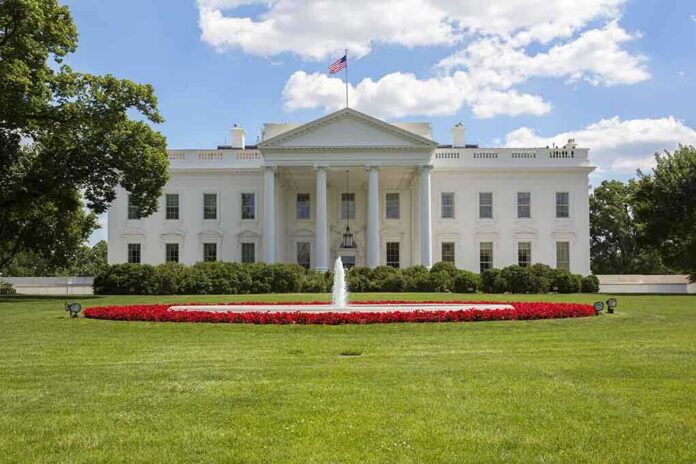
The next time a president raises a glass in a glittering White House ballroom, the real power story may be humming quietly underneath the dance floor.
Story Snapshot
- President Trump said the U.S. military is building a “massive” underground complex beneath a new White House State Ballroom.
- Trump framed the above-ground ballroom as a kind of “shed” covering the subterranean build, which he described as “top secret.”
- The ballroom project has been pitched as privately funded by donors and Trump, with no taxpayer dollars and a price tag around $400 million.
- Plans accelerated through approvals and legal challenges, with national security arguments helping keep construction moving.
A Ballroom on Top, a Bunker Below: What Trump Actually Disclosed
Donald Trump’s March 29, 2026 remarks aboard Air Force One turned a conventional renovation story into a national-security cliffhanger. He said the military is constructing a large underground complex beneath the new White House State Ballroom, with the ballroom effectively serving as the structure above it. He also emphasized protective features like bulletproof glass and drone-resistant design elements, pairing hard security language with an insistence that private money covers the visible project.
That combination—high society architecture wrapped around security engineering—explains why the story grabs people who normally ignore building projects. The headline isn’t “new venue for state dinners.” The headline is that the White House is rebuilding the part you can’t see, at a time when drones, surveillance, and rapid-response threats have reshaped how the government protects continuity of leadership. Trump’s phrasing invited questions he did not answer: how big is “massive,” and what exactly goes on down there?
The East Wing Tear-Down and the Disappearing PEOC
The underlying drama started before the “massive complex” line ever reached the public. The modernization plan required removing the old East Wing footprint and reworking what had been a longstanding emergency node: the Presidential Emergency Operations Center. The 1942-era East Wing carried layers of history and function, but it also carried constraints. The administration’s push aimed to replace cramped event capacity and outdated layouts with a bigger, modernized complex.
Demolition in October 2025 did more than clear space for a larger ballroom. The same timeline included dismantling the old emergency center, effectively forcing the creation of a new below-grade capability. That context matters because it turns the underground build from a curiosity into an operational necessity. If you remove an old continuity facility, you either replace it or accept vulnerability. On that basic point, common sense lines up with national security practice.
Private Funding: The Selling Point That Also Raises Eyebrows
Trump repeatedly stressed “not one dime” of taxpayer money for the ballroom, saying donors and his own funds are paying for it. For many Americans—especially those tired of federal overspending—that is a politically sharp message. The pitch is simple: improve a critical national asset without adding to the public bill. The implied contrast is with the usual Washington pattern of cost overruns and vague accountability.
Funding by private donors, however, also creates its own set of conservative questions: transparency, influence, and precedent. Donor-funded public works can be efficient, but they can also blur lines if the public can’t see the financial details. The reported total cost moved upward across the project’s public timeline, and donor amounts were not the centerpiece of disclosure. A private check may reduce taxpayer burden, but it does not automatically reduce public interest in oversight.
Fast-Tracked Approvals, Legal Resistance, and the Magic Words “National Security”
Projects at the White House rarely travel a straight line because aesthetics, historic preservation, and federal authority collide on every drawing. This one moved quickly anyway. Design and permitting cleared key review bodies, and the Justice Department pointed to national security in court filings. A federal judge questioned authority but ultimately allowed construction to continue. That sequence signals a familiar reality: when security arguments appear credible, the system tends to defer.
That deference can be appropriate, but it can also become a habit. Americans who value limited government often want two things at once: strong defense and restrained executive power. The ballroom project sits right on that fault line. If the underground work truly involves continuity-of-government needs, secrecy is rational. If secrecy becomes a blanket to avoid ordinary scrutiny on non-classified components, critics will have a legitimate opening.
Security Features as Architecture: Bulletproof Glass and Drone-Proof Thinking
Trump’s description of bulletproof glass and drone-proof protection is less decorative bragging than a snapshot of modern threat planning. Drones collapsed the distance between a person with bad intent and a protected target. Hardened glazing, standoff distances, and layered defenses now shape even “civilian-looking” buildings that host high-value events. A ballroom that hosts foreign leaders needs to behave like a secure facility without looking like a fortress.
That tension produces a uniquely American design problem: maintain historical character while building for today’s threat environment. The White House is both museum and command post, a stage set and a working headquarters. Conservatives who prize tradition can still accept modernization when it keeps faith with the building’s purpose. The real test is whether the visible structure stays tasteful while the invisible structure stays capable.
The Open Questions That Won’t Go Away
Trump framed the project as ahead of schedule and under budget, and he separated the public ballroom cost from the subterranean work he called “top secret.” That leaves the public with two buckets: what is disclosed and what is not. Size estimates for the ballroom and the overall East Wing expansion have varied across public descriptions, and the underground component’s scope remains undefined by design.
People over 40 have seen this movie: big federal projects rarely stay neatly inside their first narrative. Even if donors fund the ballroom, classified work can still pull in government resources and long-term maintenance costs. The responsible stance is neither panic nor blind faith. It is steady insistence on clarity where clarity is possible, and sober acceptance of secrecy where secrecy protects lives.
The political fight will hinge on what Americans believe they’re getting. If the outcome is a dignified ballroom that restores hosting capacity and a hardened continuity facility that modern threats demand, the project will look like pragmatic governance. If the outcome feels like opacity piled on opacity, opponents will frame it as elite privilege in marble clothing. Trump’s “shed” line ensured one thing: everyone will keep looking under the floorboards.
Sources:
Trump claims donor funded White House ballroom includes hidden build below security focus
US military building ‘big complex’ under White House ballroom: Trump