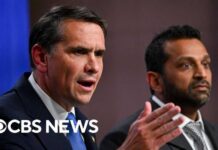
Trump just turned one Senate vote into a loyalty test that could decide who survives the next Republican primary.
Quick Take
- Trump warned he will not endorse any lawmaker, Republican or Democrat, who votes against the SAVE America Act.
- The House already passed the bill; the Senate faces a procedural test vote and a 60-vote reality check.
- The legislation pairs voter eligibility and ID rules with hot-button cultural provisions, widening both its appeal and its opposition.
- GOP leadership admits the math is tough, while Democrats frame the bill as modern voter suppression.
Trump’s endorsement threat turns policy into a political trap
President Donald Trump used a Truth Social warning to raise the price of dissent: vote against the SAVE America Act and lose his endorsement. That message matters because endorsements function like political oxygen in today’s GOP, especially in primaries where turnout skews intensely engaged. Trump didn’t aim the warning only at Democrats; he aimed it at hesitant Republicans too, signaling he expects party unity, not negotiation.
The timing also reads like strategy, not impulse. Senate Republicans planned a procedural test vote as Democrats promised to block the bill, and Trump’s message effectively dared every senator to pick a side on the record. For voters, the looming question isn’t only whether the bill passes. It’s whether a “no” vote becomes campaign footage, replayed in attack ads as proof a senator stood against “election integrity.”
What the SAVE America Act actually tries to do, and why it’s different
The bill’s core pitch is straightforward: tighten federal voter registration and voting rules by requiring proof of U.S. citizenship, strengthening voter identification standards, and limiting certain forms of mail-in voting. Those planks echo years of Republican arguments that elections need stronger guardrails. The complicating factor is that this version reportedly bundles election mechanics with cultural provisions, including issues involving transgender athletes and minors’ medical care.
That bundling changes the political math. A clean, single-issue election bill forces opponents to argue about election procedures alone. A multi-issue package gives supporters more rallying points while giving opponents more targets. From a conservative, common-sense perspective, bundling can be a feature, not a bug, if the goal is to present a unified “America First” agenda. It can also harden resistance by making compromise nearly impossible.
The Senate’s problem is not passion; it’s arithmetic
Senate Majority Leader John Thune has acknowledged the obvious obstacle: reaching the 60 votes needed to overcome a filibuster. With Republicans holding a majority but not a supermajority, passage requires a slice of Democrats to join in. That’s unlikely when Senate Minority Leader Chuck Schumer vows to fight “tooth and nail” and labels the effort “Jim Crow 2.0,” a phrase designed to unify Democrats and alarm swing voters.
That’s why the procedural test vote matters even if it fails. It forces a public roll call that can power fundraising emails, cable news segments, and—most importantly—primary challenges. Republicans can claim Democrats blocked “citizenship verification,” while Democrats can claim Republicans pushed “suppression.” The bill becomes less a legislative instrument and more a political measuring stick, useful even in defeat.
The Murkowski signal: federal mandates collide with state election systems
Sen. Lisa Murkowski’s opposition underscores a real tension that doesn’t fit neatly into party slogans: elections run through state systems, and federal mandates can disrupt established procedures. Conservative voters often prefer local control, but they also demand clean rolls and secure ballots. Murkowski’s critique suggests some Republicans see the bill’s structure as too disruptive or too sweeping, even if they support portions like proof of citizenship.
That intraparty friction is exactly what Trump’s endorsement threat tries to crush. He isn’t merely lobbying for a bill; he’s attempting to standardize Republican behavior under a single consequence: cross him on this, and he’ll help end your career. Whether voters like that depends on what they value more—party discipline and decisive action, or independent representation. The next primaries will answer that louder than any press conference.
Why Democrats call it suppression, and what voters should measure for themselves
Democrats argue stricter ID and registration requirements can burden eligible voters who lack documents, including some elderly citizens and low-income voters. That concern should be tested against specifics: What counts as acceptable proof? How easy is it to obtain? Are states given workable implementation timelines? Conservatives can reasonably insist that citizenship verification and identity checks are normal expectations in serious democracies, while also demanding the rules avoid trapping lawful voters in bureaucratic dead ends.
Trump’s messaging emphasizes noncitizen voting fears and broader cultural grievances. Critics counter that noncitizen voting is rare and that the bill solves a problem out of proportion to its impact. The responsible way to judge that dispute is to separate two questions: whether the principle is sound (citizens decide U.S. elections) and whether the implementation is precise (the law targets fraud without creating mass inconvenience). Legislators will be judged on both.
The endgame: attach it, split it, or turn it into a campaign weapon
House Republicans have floated paths forward that don’t rely on goodwill: attach portions of the bill to must-pass legislation, push incremental wins, or dare Democrats to hold the line under public pressure. Each path has tradeoffs. Attaching it raises the stakes and risks shutdown-style brinkmanship. Splitting it could pass the most defensible parts but disappoint activists who want the full package. Using it as a campaign weapon guarantees airtime but delays any real reform.
NEW: President Trump fires off a warning to Republicans, tying the Save America Act directly to the party’s future in the Senate.
“Not passing the SAVE AMERICA ACT will lead to the worst results… An Unrecoverable Death Wish!!!”
He doesn’t stop there — he also pushes to scrap… pic.twitter.com/w5aMARP6I1
— Fox News (@FoxNews) April 25, 2026
Trump appears to prefer maximal leverage: no compromises, clear villains, and consequences for defectors. That approach fits his political brand and speaks to voters tired of Washington half-measures. The risk is institutional: a Senate built to require consensus doesn’t bend easily, and threats can harden opposition. If the SAVE America Act stalls, the story won’t end. It will simply migrate into campaign season, where “who voted yes” becomes the new litmus test.
Sources:
Trump warns he won’t endorse lawmakers who oppose Save America Act
Trump urges Senate to pass SAVE America Act, warns he’ll oppose lawmakers who vote no
Donald Trump, SAVE America Act, Republicans, voting, John Thune, Chuck Schumer