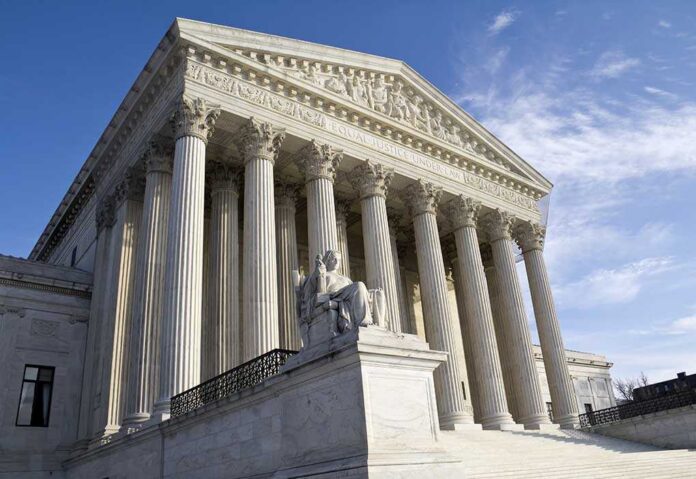
President Trump walked out of his own Supreme Court hearing while lawyers argued whether thousands of American newborns could lose their constitutional right to citizenship.
Story Snapshot
- Trump’s executive order attempts to end birthright citizenship for babies born to undocumented or temporary-status parents, contradicting 125 years of legal precedent
- Every lower court has blocked the order as unconstitutional, but the Supreme Court heard arguments on April 1, 2026, in what could redefine American citizenship
- ACLU lawyers warned the policy threatens thousands of babies with statelessness while Trump attended then departed the high-stakes arguments
- The case affects an estimated 300,000 to 400,000 annual births and tests whether a president can override the 14th Amendment without Congress
When Constitutional Rights Meet Executive Ambition
The 14th Amendment contains just 16 words on citizenship: “All persons born or naturalized in the United States, and subject to the jurisdiction thereof, are citizens.” Those words have stood unchallenged since 1868, reinforced by the Supreme Court’s 1898 ruling in United States v. Wong Kim Ark. Trump’s January 20, 2025 executive order attempted to rewrite this bedrock principle on his first day back in office, declaring that babies born after February 19, 2025 to parents without permanent legal status would no longer automatically receive citizenship. Within two hours, the ACLU filed suit.
A Legal Blockade From Every Direction
The Trump administration’s losing streak in court reads like a prosecutor’s dream. Federal judges blocked the order in February 2025. An appeals court upheld that block in August. Another appeals court affirmed the decision in October. By the time the Supreme Court agreed to hear Barbara v. Donald J. Trump, lower courts had unanimously rejected the administration’s arguments. The ACLU’s Cody Wofsy put it bluntly: “No judge has bought their arguments.” The administration contends the 14th Amendment was meant only for descendants of former slaves, an interpretation so narrow it would require ignoring more than a century of legal application.
The Human Cost of Constitutional Revision
Behind the legal abstractions sit real families facing impossible choices. Wofsy described parents leaving hospitals with newborns, terrified of arrest under Trump’s enforcement apparatus. The order affects roughly four percent of all U.S. births annually, potentially rendering thousands of babies stateless or forcing families into the shadows. Immigration advocacy groups including LULAC, Make the Road New York, and the Asian Law Caucus joined the lawsuit representing communities where fear has replaced the American promise. Trump’s position rests on limiting what he calls “birthright tourism,” but the collateral damage extends to families who’ve lived in America for years, contributing to communities and raising children who know no other home.
The nationwide class action certification means any ruling affects every baby born under these circumstances across all 50 states. Democracy Defenders Fund legal director Tianna Mays and ACLU state affiliates from New Hampshire to Maine coordinated the challenge, building a coalition that mirrors the geographic scope of Trump’s order. The preliminary injunction granted in July 2025 provided temporary relief, but families remain in limbo pending the Supreme Court’s decision. Hospital administrators face confusion about citizenship documentation, and immigrant communities operate under a cloud of uncertainty that affects prenatal care access and family planning.
Trump’s Dramatic Exit Strategy
Trump’s decision to attend oral arguments broke presidential norms, but his departure mid-hearing raised eyebrows even in a capital accustomed to his unconventional approach. The optics suggested either confidence in his legal team or discomfort with arguments that weren’t landing. ACLU President Anthony Romero noted his organization’s historical preparation for defending constitutional principles, framing the case as a predictable battle given Trump’s 2018 campaign promises to end birthright citizenship through executive action. That earlier attempt never materialized due to obvious legal barriers. This time, Trump bypassed those concerns, betting a more conservative Supreme Court would embrace his reasoning where lower courts refused.
What Hangs in the Balance
The Supreme Court’s ruling could fundamentally alter American identity. A decision upholding Trump’s order would mark the first time in U.S. history that executive action successfully overrode birthright citizenship without congressional amendment to the Constitution. The short-term implications involve immediate status determinations for babies born since February 2025, potentially subjecting them to deportation proceedings despite birth on American soil. Long-term consequences reach further: redefining citizenship criteria opens doors to future restrictions based on parental characteristics, employment status, or other factors currently irrelevant under the 14th Amendment’s clear language. Economic disruptions would follow as families flee or avoid hospital births, and the social fabric of immigrant communities would fray under enforcement pressure.
The administration’s argument requires the Supreme Court to ignore Wong Kim Ark’s explicit holding that birthright citizenship applies to children of non-citizen parents. Every brief filed by plaintiffs emphasizes the “plain language” of the amendment, which contains no carve-outs for parental immigration status. Conservative principles traditionally favor strict constitutional interpretation and restraint on executive overreach. Trump’s order represents executive expansion at its most aggressive, claiming authority to reinterpret constitutional text without legislative action. The tension between immigration enforcement goals and constitutional fidelity creates an uncomfortable position for justices who value both border security and textual originalism.
Sources:
Barbara v. Donald J. Trump – ACLU Case Page
Legal Groups File Supreme Court Brief Supporting Birthright Citizenship – ACLU Press Release
Barbara v. Donald J. Trump – ACLU New Hampshire
Federal Appeals Court Upholds Block on Trump Birthright Citizenship Order – ACLU Press Release
Trump Seeks New Birthright Citizenship Restrictions as Case Goes to Supreme Court – NBC26