
What began as a routine traffic stop near Independence Mall in June 2026 has unraveled into one of the most disturbing missing-persons investigations Philadelphia has seen in decades, and the reason it matters goes beyond the shock value of the discoveries: it is a case study in how digital evidence, once nearly impossible to generate at scale, can now outpace the physical evidence needed to prove a crime in court.
Key Points
- Investigators have connected at least seven missing women to a property at 417 West Chew Avenue in Philadelphia’s Olney section, formerly occupied by Raymond “R.C.” Horsch, who died in 2025, and his son Eugene Horsch.
- Police recovered an estimated one million digital files from the home — roughly 600,000 images, 70,000 videos, and more than 10,000 pages of writings — of which only about 5% had been reviewed as of a September 2026 briefing.
- Bones were recovered from the backyard in October 2026 and sent to the Medical Examiner’s Office; investigators have not yet determined whether they are human or animal remains.
- A hidden safe was discovered concealed inside the home’s walls during demolition work, with its contents still unknown.
- Eugene Horsch faces federal firearms and drug charges from his June arrest; no homicide charges have been filed in connection with the missing women.
How the investigation began
The case did not start as a homicide inquiry. It started as a traffic stop. In June 2026, Philadelphia police pulled over Eugene Horsch, 44, near Independence Mall and found him in possession of firearms, illegal narcotics, and fraudulent law enforcement credentials. A woman in the vehicle carried a fake ID bearing the photograph of a woman later identified as missing, but under a different name. That single detail — a mismatched face and name on a counterfeit document — gave investigators the thread that led them to 417 West Chew Avenue, a property Eugene had inherited from his great-aunt’s estate in 2007.
What they found inside reframed the case entirely. Executing search warrants, detectives and FBI agents recovered what Inspector Raymond Evers described at a September 2026 news conference as roughly one million digital files — about 600,000 images, 70,000 videos, and more than 10,000 pages of handwritten material — depicting dozens of individuals, many appearing unconscious or lifeless. At the time of that briefing, investigators had reviewed only about 5% of the material, a reminder that digital forensic review at this scale is measured in months, not days.
The physical search: pits, drums, and a hidden safe
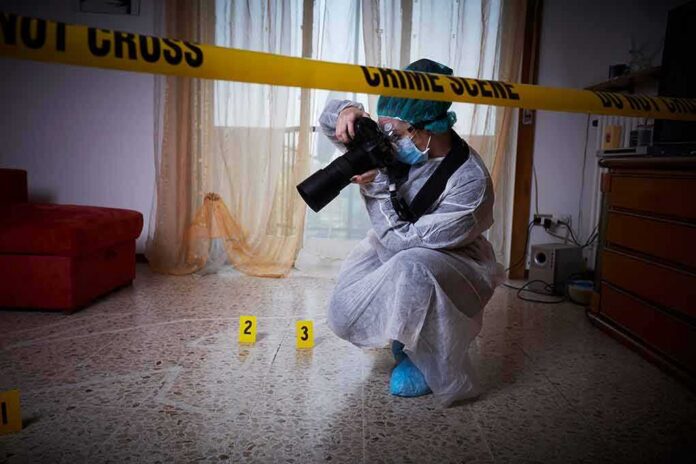
Digital evidence pointed investigators toward specific violence; physical evidence has been slower to confirm it. Excavation crews have worked the property’s yard in archaeological fashion, sifting soil in shallow layers and applying luminol, a chemical reagent used to detect trace blood residue invisible to the naked eye, before collecting DNA-viable samples for laboratory comparison against an exclusion list that includes both Horsch men and known associates. Crews also uncovered an eight-foot-deep, brick-lined pit resembling an outhouse structure, and a homemade chemical setup built around a 55-gallon drum connected to the home’s water lines, now under forensic analysis.
Inside the house, demolition crews pulled a hidden safe from behind interior walls, its age and contents undisclosed pending a locksmith’s attempt to open it. Investigators also recovered five urns believed to contain human ashes, potentially including Raymond Horsch himself, a relative, and a family friend. Then, on October 15, 2026, the Medical Examiner’s Office responded to the property after bones were found in the backyard. Animal remains — including possum carcasses — had already turned up in the same soil, complicating identification, which is why forensic anthropologists rather than general investigators are typically brought in to make the first determination between human and animal bone before anything proceeds to DNA testing.
What the evidence connects, and what it doesn’t — yet
Police have been precise in their public language, and that precision matters. They have said seven women are connected to the property through photographs, video, and testimony, and that five of those women are believed deceased. That is an evidentiary association, not a forensic determination of homicide. No human remains have yet been confirmed to belong to any of the missing women, months into an investigation that has already spanned multiple extended searches. The distinction between a person appearing in disturbing footage and a person whose death has been forensically established is the entire legal hinge on which any future charges will turn, and it is why, as of the most recent reporting, no homicide charges have been filed against either Horsch.
Eugene Horsch remains in federal custody on the firearms, narcotics, and fraudulent-credential charges stemming from his arrest — charges that carry the possibility of a life sentence if he is convicted on all counts, independent of whatever the ongoing search ultimately produces. Raymond Horsch, described by associates as an erotic photographer and filmmaker who referred to himself in his own writings as an “empathetic serial killer,” died in 2025 and was never charged with any crime related to the women found in his archive. Reporting from the Philadelphia Inquirer indicates Eugene recruited women struggling with addiction, offering money and drugs in exchange for participation in films and photographs — a recruitment pattern that explains why the victims described in this case were especially vulnerable and, investigators have acknowledged, especially difficult to trace once they went missing.
Bones have been unearthed in the backyard of a Philadelphia ‘house of horrors’ linked to seven missing women, while FBI investigators have uncovered a hidden safe concealed beneath the floorboards of the notorious property https://t.co/sbdvVU6H6v 🔗 pic.twitter.com/Jl7xfbefAY
— Daily Mail US (@Daily_MailUS) October 19, 2026
Why cases like this take so long to resolve
The gap between a headline-grabbing discovery and a courtroom charge is not unique to Philadelphia; it is structural. Digital forensic examiners work under chain-of-custody standards that require every file, every derivative copy, and every access event to be documented in a way that will survive cross-examination — a process the National Institute of Standards and Technology and professional bodies like SWGDE have codified precisely because digital files are trivially easy to alter and correspondingly easy to challenge in court if handling isn’t airtight. At the volume recovered here — roughly a million files — simply cataloging the material consumes months before investigators can even begin correlating specific images or videos to a specific missing person, let alone to a specific criminal act.
That lag also explains why cases involving a large body of disturbing material tend to generate public narratives that outrun the legal record. Academic research on crime coverage has long found that cases combining graphic material, an unusual offender, and missing victims draw disproportionate and sustained media attention compared with more routine homicides. None of that diminishes what investigators have reported finding in Olney. It does mean that the responsible way to follow this case is to track what has been forensically confirmed — bones sent for testing, a safe awaiting a locksmith, charges actually filed — rather than to treat association as proof before the laboratory work is done.
Sources:
nypost.com, abcnews.com, nbcphiladelphia.com, ground.news, phillyburbs.com, thesis.eur.nl, swgde.org
© standardnewsdaily.com 2026. All rights reserved.