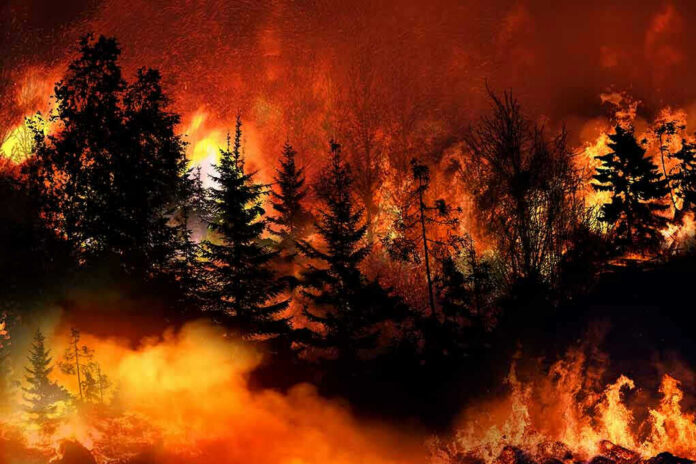
As Utah’s Cottonwood Fire explodes into the largest wildfire in America, officials blame “human causes” while tightening emergency powers that hit everyday citizens hardest.
Story Snapshot
- Nation’s largest active wildfire scorches over 92,000 acres in Utah with 0% containment.
- Officials classify the Cottonwood Fire as human-caused while the exact spark remains under investigation.
- Governor Spencer Cox declares a state of emergency and hands statewide fireworks power to one unelected forester.
- Power shutoffs, evacuations, and closures strain families as media pushes “most destructive in history” panic.
Wildfire Turns Utah Forest Into a Disaster Zone
Utah’s Cottonwood Fire has turned parts of Beaver and Piute counties into a charred disaster zone, making it the largest active wildfire in the United States.[5] The blaze has torn through more than 70,000 acres in mapping reports and has rapidly pushed past 90,000 acres as conditions worsen.[5][7] Fire crews describe “extreme” fire behavior driven by strong winds and dry air, which keep aircraft grounded and limit safe options on the ground.[6][7] Despite days of hard work, containment remains at 0%, leaving rural communities anxious and on edge.[5]
State officials say the Cottonwood Fire is human-caused, fitting a long pattern where most Utah wildfires start with people, not lightning.[8][16] Utah’s state forester and local fire managers report that the blaze was discovered on June 22 in Beaver County and quickly raced through forest and resort areas.[8] Investigators have not yet released the exact ignition source, only confirming that the cause traces back to human activity, which could include carelessness, equipment, or other behavior.[1][2][8] That gap between “human-caused” and “who did what” is already feeding public doubt and frustration.
Emergency Orders, Fireworks Bans, and Expanded State Power
Governor Spencer Cox has declared a state of emergency as the fire spreads, warning it could become the most destructive and costly fire in Utah history.[9][10] His order goes beyond basic firefighting support and gives the state forester, Jamie Barnes, statewide power to restrict or ban fireworks through July 5.[3][6] That decision effectively moves authority away from local city councils and county leaders and into the hands of one appointed official.[6] For many conservatives, this raises hard questions about emergency powers, local control, and how quickly unelected regulators can reach into community traditions like Independence Day celebrations.
State leaders defend the fireworks limits by pointing to one clear fact: more than 75% of Utah’s wildfires are started by people, not nature.[16] Barnes says fires this year are starting closer to homes and communities, making it harder and more dangerous for crews to protect both lives and property.[3] National fire and climate research shows that human activity is now the main driver of “fire weather” in the West, where hotter, drier conditions make every spark more dangerous.[17] Even so, many families who follow the rules feel they are paying the price for a small number of reckless actors and for years of mismanaged forest policy and environmental red tape.
Communities Face Evacuations, Power Shutoffs, and Media Panic
The Cottonwood Fire has already forced evacuations from Eagle Point Resort and nearby cabin communities, with more towns told to be ready to leave at short notice.[1][3] Photos from the scene show destroyed cabins, burned-out structures, and blackened slopes above Beaver and Piute counties.[8] Yet officials still cannot give residents a clear count of how many homes and buildings are gone, saying total property loss remains “unknown” while crews focus on active fire lines.[3][9] That uncertainty adds stress for families waiting to learn if they still have a house, a business, or a church to return to.
Why are fireworks banned statewide in Utah?
Utah's Cottonwood Fire explodes to over 92,000 acres, the nation's largest wildfire. Fireworks are now banned statewide, impacting July 4th celebrations.#CottonwoodFire #UtahWildfire #FishlakeNationalForest #WildfireBan #BreakingN… pic.twitter.com/u7t6vU7lW5
— JQJO USA Environment English (@Jqjoenviroment) June 29, 2026
Utility company Rocky Mountain Power has carried out public safety power shutoffs in parts of southern Utah, cutting electricity to hundreds of customers and affecting up to tens of thousands of people across several towns.[3][7] The company says this step helps prevent sparks from power lines during dangerous winds, but for residents it means spoiled food, lost income, and trouble staying informed as the fire spreads.[3] Some already view these shutoffs as another form of top-down pressure, piling on top of evacuation orders, road closures, and forest restrictions that reshape daily life without much say from the people living there.[3][7] At the same time, national media outlets brand the Cottonwood blaze “catastrophic” and “the most destructive in state history,” language that stirs fear but rarely explores how policy, prevention, and personal responsibility must work together.[5][9]
Human-Caused Fire in a Human-Shaped Landscape
Researchers who study fire in Utah and across the West say the Cottonwood disaster sits at the crossroads of two truths: human actions start most fires, and human-driven climate change is making those fires harder to fight.[14][17] One long-term study found that hotter temperatures and longer dry seasons in Utah lead to large jumps in burned area across many landscapes, especially forests.[14] National data also show that while the number of fires has stayed roughly flat, the total area burned has grown as “megafires” like Cottonwood become more common.[17] This means personal responsibility matters more than ever, from campfires and machinery to fireworks and power lines, because each mistake now plays out in a forest primed to burn.
For many conservative families, the Cottonwood Fire is not just another breaking news alert; it is a warning about what happens when human behavior, heavy-handed regulation, and a stressed land collide. They watch as a human-caused blaze destroys cabins and resorts, while emergency orders expand state power over holidays and local decisions.[8][6] They see media rush to frame the story as pure climate crisis, with little attention to the people who ignored burn bans, left trash fires smoldering, or pushed to keep forests locked away from healthy thinning and management.[15][17] As the smoke thickens over southern Utah, many patriots will be asking not only how this fire started, but whether those in power will use the crisis to protect communities—or to grab even more control.
Sources:
[1] YouTube – Largest wildfire in the US spreads through tinder-dry forest in Utah
[2] Web – Utahns on notice as fast-moving as the Cottonwood Fire, the largest in …
[3] Web – Cottonwood Fire, the largest in the US, spreads overnight, forcing …
[5] YouTube – Utah’s Cottonwood Fire could be the worst in state’s history
[6] Web – Residents on notice as fast-moving fire in Utah, the largest in the …
[7] YouTube – Cottonwood Fire, nation’s largest wildfire, burns 92,000 acres in …
[8] Web – Nation’s largest wildfire grows to over 70,000 acres in Southern Utah
[9] Web – Photos capture nation’s largest Cottonwood Fire, its extensive damage …
[10] YouTube – The “Cottonwood Fire” is Becoming One of the Most Destructive Fires …
[14] Web – July-August human-caused wildfire comparisons: 159 in 2021 471 …
[15] Web – [PDF] Historical patterns of wildfire ignition sources in California …
[16] Web – [PDF] Large projected increases in area burned and wildfire frequency …
[17] Web – [PDF] All About Wildfires – Natural History Museum of Utah
© standardnewsdaily.com 2026. All rights reserved.