
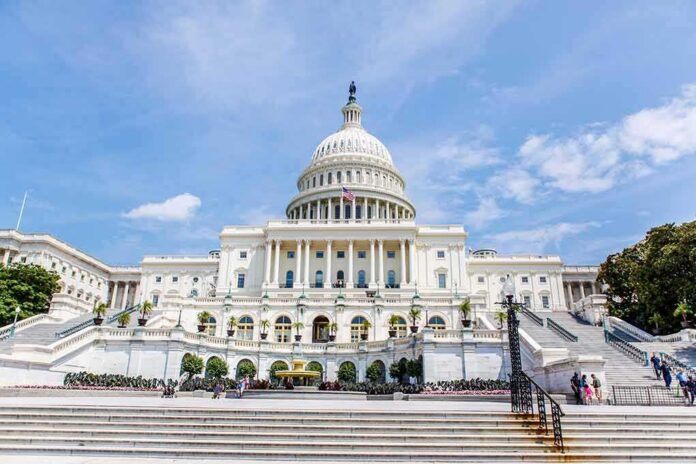
Control of the United States Senate now hinges on a handful of razor-thin races, with Fox News’ own tracking showing Republicans and Democrats deadlocked at 47 seats each heading into the final week before the midterms.
Quick Take
- Fox News Power Rankings show a 47-47 Senate split with six true toss-up races left to decide control.
- Toss-up states include Alaska, Iowa, Maine, Michigan, Texas, and Ohio, spanning red, blue, and swing territory.
- Polls in Texas, Ohio, and Maine show margins inside or near the margin of error.
- History shows the president’s party almost always loses Senate seats in midterms, adding pressure on Republicans.
- Expert election raters have a strong track record, but close races still carry real uncertainty.
Six Races Could Decide The Senate
Fox News updated its Power Rankings on October 27, placing Democrats and Republicans at 47 seats apiece. That leaves six races rated true toss-ups: Alaska, Iowa, Maine, Michigan, Texas, and Ohio. Sen. Dan Sullivan is defending his seat in Alaska, one of the most closely watched contests of the cycle. The spread of these states, from deep-red Texas to competitive Maine, shows the fight for the Senate is not limited to one region or one type of voter.
Other outlets frame the battlefield a bit differently. Cook Political Report listed seven battleground states as of October 20, while a Fox News video segment referenced nine states in play. These differences likely come down to how strict each outlet is when labeling a race a “toss-up” versus a “lean” or “battleground,” not a real disagreement about which states matter most.
Texas And Ohio Show Tight Numbers
In Texas, Democrat James Talarico leads Republican Ken Paxton by five points in one Cook Political Report poll released October 21, a margin just outside the 3.2-point margin of error. In Ohio, Suffolk University found Democrat Sherrod Brown ahead of Republican Jon Husted by three points in late-October polling. Both races remain close enough that small shifts in turnout could flip the outcome either way.
Maine presents an even tighter picture. One late-October poll showed Republican Sen. Susan Collins at 47% against Democrat Troy Jackson at 46.5%, a gap inside typical polling error. A separate battleground poll from the firm Cygnal, conducted October 15 to 18 across nine states, found a 14-point shift toward Democrats among the voters it surveyed. Polling snapshots like these can move quickly in the campaign’s final days.
History Weighs Against The President’s Party
Senate control has changed hands ten times since World War II, making this kind of close fight far from unusual. Data from Reuters shows the president’s party has nearly always lost seats in the House, the Senate, or both during midterm elections over the past 80 years. When that party does gain seats, the gain is usually just one or two, compared to average gains of around five seats in presidential election years. That pattern puts pressure on Republicans this cycle.
Election raters do have a solid record of accuracy. A review of more than 10,000 races rated by the Cook Political Report between 1984 and 2024 found its “Likely” calls were correct 97% of the time, and “Solid” ratings were right almost every time. Still, the ratings exist precisely because a small number of races are genuinely hard to call, and this year’s six toss-ups fall into that harder category.
What Voters Should Watch Next
With less than a week before Election Day, campaigns in Alaska, Iowa, Maine, Michigan, Texas, and Ohio are likely to see a final surge of advertising and candidate visits. Polling averages will keep shifting as more surveys come in. Given how often the Senate has flipped in the past and how tight current polling margins are, the outcome in several of these states may not be clear until votes are fully counted.
Five numbers about SpaceX CEO Elon Musk, from Senator Bernie Sanders’s October 27 post, which has no link, image or date range. We set each beside filings, index readings and FEC records. Which would you want a source and date beside first? https://t.co/aLJRmj2X9t
— Truths from Grok (@truthsfromgrok) October 28, 2026
For voters on both sides of the aisle frustrated with gridlock in Washington, this split Senate map reflects a deeper reality. Neither party holds a commanding national advantage right now, meaning whichever party wins will likely do so by the thinnest of margins, with a mandate that may not match the scale of problems facing the country.
Sources:
facebook.com, foxnews.com, fox61.com, nytimes.com, nbcnews.com, foxwilmington.com, reuters.com
© standardnewsdaily.com 2026. All rights reserved.