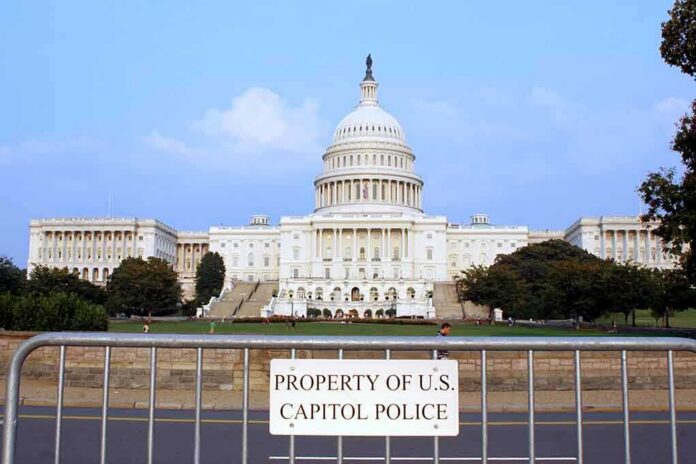
President Trump’s move to keep National Guard troops in Washington, D.C., through 2029 turns the nation’s capital into a long‑term test of federal power, crime policy, and the future of constitutional limits.
Story Snapshot
- National Guard deployment in D.C. is now set to run through Inauguration Day 2029, the end of Trump’s second term.
- Trump’s executive orders cite a “crime emergency,” even though violent crime was near 30‑year lows when troops first arrived.
- Nonpartisan studies say the Guard has little to no impact on violent crime, fueling media and left‑wing attacks on the mission.
- A federal appeals court has allowed the deployment to continue for now, highlighting D.C.’s unique status under direct presidential control.
Trump Extends Guard Presence as Crime Fight and Constitutional Test
President Donald Trump has ordered that National Guard troops remain deployed in Washington, D.C., until January 20, 2029, or until he chooses to end the mission. The Pentagon confirmed the extension, making this the longest domestic National Guard law‑and‑order deployment in American history. Trump first sent troops in August 2025 under a “crime emergency” order and created the D.C. Safe and Beautiful Task Force to restore public order and clean up the city’s streets. This move fits his broader promise to crack down on crime, homelessness, and disorder that many feel Democrats ignored for years. Local D.C. leaders opposed the deployment from the start, but because the city is a federal district, the president — not a governor — controls the Guard there.
Trump’s executive orders put the federal government in charge of the local police force and brought in thousands of Guard members from D.C. and other states. Supporters see this as a firm stand for law and order after decades of soft‑on‑crime policies and permissive attitudes toward protests and encampments. For many conservatives, the extended mission shows Trump is willing to use every legal tool to protect citizens and federal property when local leaders will not. The Pentagon and Trump’s team continue to describe the deployment as a success, saying it backs up police, deters street crime, and sends a clear message that chaos will not be tolerated in the nation’s capital.
Crime Numbers, Cost Concerns, and Media Attacks on the Mission
The crime picture in D.C. is complicated and is at the center of the fight over the Guard. When Trump declared a crime emergency, violent crime in the city was near a 30‑year low, even though some categories like car theft were troubling and highly visible. A Senate Homeland Security report found no clearly proven impact on overall crime directly tied to the Guard, a point critics now repeat often. A study from the Niskanen Center and another from the Center for American Progress argue that violent crime would have dropped anyway and say the Guard mostly reduced petty property offenses in public spaces. These findings are used by mainstream outlets to paint the deployment as wasteful and “ineffective,” fitting a familiar media pattern of attacking Trump‑backed law‑and‑order tools.
The financial cost gives those same critics another talking point. Senate staff estimated the deployment would cost hundreds of millions of dollars through 2026, with daily expenses in the millions for food, housing, and patrols. By 2029 the total price tag could reach into the billions, a figure many on the left cite as proof of “overreach” and “militarization.” But that argument ignores how much money has already been burned on failed anti‑crime grants, diversity programs, and bureaucracy while families and businesses endured years of unsafe streets. For many right‑leaning Americans, spending to support the Guard looks far more justified than spending to prop up the same local governments whose policies helped fuel the crisis.
Courts, Governors, and the Fight Over Federal Power in Cities
The deployment has triggered a major legal and political struggle over who really controls America’s cities. The D.C. attorney general sued the Trump administration, calling the Guard presence “unlawful” and arguing that using troops for domestic patrols crosses constitutional lines. A federal district judge initially agreed in part, saying the president can protect federal functions but cannot simply federalize the D.C. Guard or bring in out‑of‑state troops for general crime control whenever he wants. However, the U.S. Court of Appeals for the D.C. Circuit stepped in and allowed the deployment to continue while the case goes forward, noting that Trump might succeed because D.C. is not a state and falls under unique federal authority.
National Guard deployment to DC will last through Trump’s term https://t.co/6WQiRDDstq pic.twitter.com/Ir98JVJEsO
— Fort Morgan Times (@FortMorganTimes) July 17, 2026
Democratic‑leaning officials outside D.C. have also tried to push back. Local leaders and allied advocacy groups have pressured governors who sent their Guard units to Washington, claiming the mission “misuses” troops and harms communities. At the same time, mainstream media have begun to describe the Guard presence as a “threat to democracy” and an “occupation,” language that alarms many conservatives who see it as softening the public for future attacks on legitimate uses of force and possibly on the Second Amendment. Yet despite the noise, the Pentagon continues planning around the 2029 timeline, and Guard leaders have told staff to prepare for a long mission focused on patrols, support to law enforcement, and city clean‑up efforts. For Trump supporters, the extended deployment is both a stand against urban chaos and a warning about how far the left will go to block strong policing, even when the Constitution gives a clear path for national leadership.
Sources:
npr.org, nbcpalmsprings.com, washingtonexaminer.com, usatoday.com, abcnews.com, thehill.com, huffpost.com, ms.now, cnn.com, niskanencenter.org, en.wikipedia.org
© standardnewsdaily.com 2026. All rights reserved.