
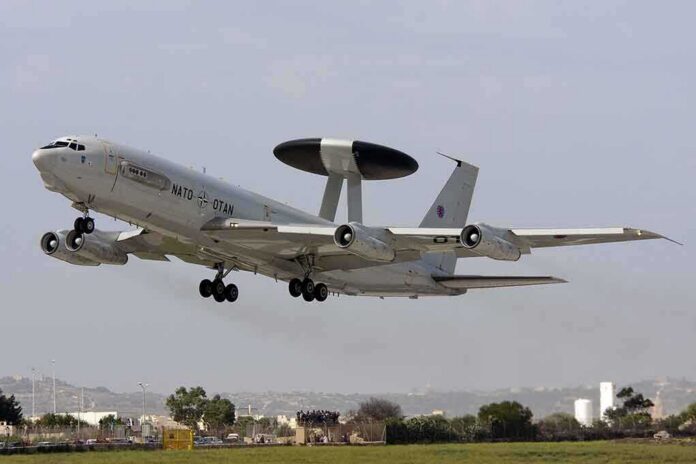
As Washington pulls back troops and high‑end weapons from Europe, the Trump administration is telling NATO allies it is time to cover the gaps themselves or face a very different alliance.
Story Snapshot
- The United States is speeding up troop and asset withdrawals from Europe and NATO structures.
- Washington is now asking European allies to assign more of their own forces and hardware to NATO to plug “capability gaps.”
- Key U.S. deep‑strike assets, bombers, carriers, and jets available for a European war are being sharply reduced.
- Experts warn Europe is still heavily dependent on U.S. firepower and support, especially against Russia.
Trump Team Pushes Europe to Step Up as U.S. Steps Back
President Trump’s team has begun to turn long‑standing complaints about NATO burden sharing into hard policy on the ground. U.S. commanders have already announced the withdrawal of 5,000 troops from Europe, including an armored brigade combat team and a long‑range fires battalion, with more redeployments expected over the next several years as allies build capacity.[2] Separate reporting says Washington is accelerating a broader troop drawdown from European bases, aiming to return to roughly pre‑2022 levels and briefing allies on the plan at an upcoming NATO force sourcing conference.[4]
At the same time, the administration is asking European members to put more of their own militaries on the table for NATO. According to testimony from the United Kingdom’s top military officer, the United States has asked Britain and other allies to identify forces and equipment they hold back nationally and formally assign more of those assets to NATO for use in a crisis.[1] The goal, he said, is to “bolster the capacity” of the alliance as U.S. assets are pulled away, turning undeclared European strength into concrete, pledged capability.
Deep‑Strike Cuts Expose NATO’s Weak Spots
The biggest shock for many European capitals is not just troop numbers but what kind of power is leaving. Reports from European media describe a U.S. plan to withdraw or halve access to deep‑strike capabilities for NATO, including long‑range bombers like the B‑2 and B‑52, missile‑armed submarines, and aircraft carriers, along with cuts to fighter jets, maritime patrol planes, and tanker aircraft.[6] A separate analysis notes that U.S. support for NATO in a crisis may be reduced by about half in strategic bombers and by one‑third in fighter jets, with no U.S. submarines provided and reduced armed drone support.[11]
Defense analysts warn that non‑U.S. NATO members rely heavily on America for exactly these high‑end missions. One respected British institute writes that almost all European allies still depend on the U.S. military for critical tasks such as suppression of enemy air defenses, airborne electronic attack, command and control, and rapid resupply of munitions in any major war.[12] Without those U.S. “enablers,” NATO could face a dangerous capability gap against a heavily armed Russian military, especially in the early days of a conflict, unless Europe invests fast to close those holes.[11]
Europe Asked to Fill Gaps, but Can It Deliver in Time?
NATO’s senior leadership is trying to calm fears even as Washington pulls back. Secretary General Mark Rutte has argued that the current reduction of several thousand rotational U.S. troops, and a cut in the number of brigades from four to three, will be structured and should not undercut NATO’s overall defense posture.[8] U.S. Supreme Allied Commander Europe General Alexus Grynkewich has said that as the “European pillar” grows stronger, the United States will shift to providing only those critical capabilities allies cannot yet field, and that a gradual redeployment of American forces should be expected as Europe builds capacity.[2]
But independent studies show how far Europe still has to go if Washington really steps back. One major European policy paper concludes that Russia’s war on Ukraine exposed the “sorry state” of many European militaries and their deep dependence on U.S. logistics, intelligence, and high‑end systems.[5] Another estimate calculates that if the United States effectively withdrew, Europe would need the equivalent of 50 additional heavy brigades—matching the fighting power of about 300,000 U.S. troops—to replace American armored forces in a major war with Russia, plus large annual spending increases to fund the equipment.[7]
Burden Shifting, U.S. Interests, and What It Means for American Conservatives
For decades, American taxpayers and troops have carried the lion’s share of Europe’s defense. Conservative defense voices argue that this long‑term overcommitment lets wealthy European governments underspend on their own militaries while Washington borrows money, fuels inflation at home, and stretches its forces thin across the globe.[3] A growing body of work from think tanks on both sides of the Atlantic now says it is both safe and necessary for the United States to reduce its burden in Europe and push allies toward real strategic responsibility.[3]
At the same time, even some hawkish experts warn that a steep or chaotic pullout could harm U.S. interests. An analysis prepared for NATO’s own transformation command stresses that the remaining U.S. presence in Europe is already a fraction of its Cold War size but is still vital for deterrence and for projecting American power into other regions.[2] Too sharp a drawdown, that paper argues, could weaken Washington’s global reach and shake allied trust, even as it relieves some pressure on the U.S. defense budget.
Sources:
[1] Web – U.S. Asks Europe to Plug NATO’s Military Gaps as It Withdraws
[2] Web – US plans to accelerate troop withdrawal from Europe
[3] Web – More US troop withdrawals from Europe expected, NATO …
[4] Web – Stop bargaining with Europe, start leaving – Defense Priorities
[5] Web – US planning faster troop withdrawal from Europe, newspaper says
[6] Web – US weighing accelerated troop drawdown in Europe – report
[7] Web – US withdraws long-range military capabilities from NATO | Euronews
[8] Web – US sets 2027 deadline for Europe-led NATO defense, officials say
[11] Web – The Pentagon will withdraw roughly 5000 U.S. troops from Germany …
[12] YouTube – US plans to reduce NATO support for Europe | DW News
© standardnewsdaily.com 2026. All rights reserved.