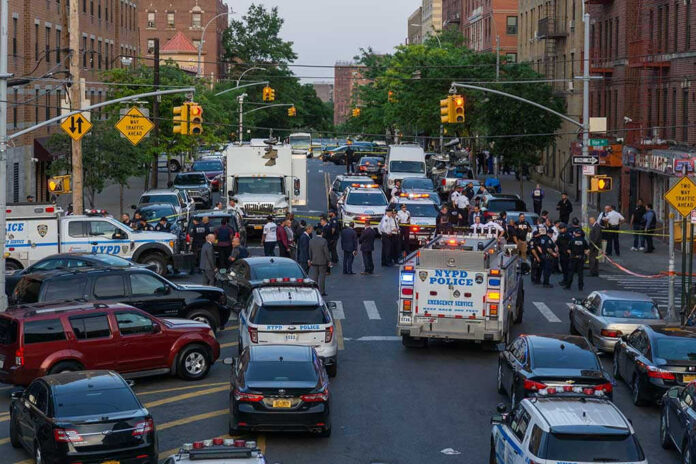
Nine people lay injured in a New York City park while officials offered few hard facts about how, or why, it happened.
Story Snapshot
- Nine pedestrians were struck by a woman riding a motorcycle in a New York City park, police said [2].
- Officials have not released evidence showing whether the act was intentional or accidental [2].
- No case number, formal charges, or named witnesses have been made public yet [2].
- Summer often brings more motorcycle crashes, but intent claims require proof [11].
Police Confirm Injuries, But Key Facts Remain Unclear
New York City police said a woman on a motorcycle entered a park and struck nine pedestrians, leaving multiple people injured [2]. The report describes a chaotic scene but does not establish the rider’s intent. Officials have not released a case number or a detailed incident report. Prosecutors have not announced charges. Without those records, the public cannot see the facts that would explain how the crash began or whether the rider broke any laws beyond entering restricted space [2].
Reporting so far leans on one outlet and police confirmation of injuries, but it offers limited details about speed, control, or mechanical issues [2]. No named witness statements appear in the coverage. No video from city or park cameras has been released. This gap creates a vacuum that headlines can fill with loaded words like “plows through,” which imply intent. That frame can shape public opinion before investigators finish the work needed to prove what actually happened [2].
Why Intent Matters And What Evidence Would Show It
Investigators usually need several things to judge intent or recklessness. Police incident reports describe the rider’s actions and conditions at the scene. Forensic crash work can estimate speed, braking, and steering. Video can map the path and timing. Witness statements can show if the rider appeared to aim, panic, or lose control. None of those items have been released yet. Without them, claims about motive or malice are unproven and should be treated as early theories, not settled facts [2].
Officials could answer core questions by releasing a basic summary with a case number, time stamps, and initial observations. If mechanical failure or a sudden obstruction occurred, forensic notes would help. If the rider ignored barriers or signs, video and scene photos would matter. Absent that, both supporters and critics fill the blanks with their own beliefs. That cycle feeds distrust on the left and right, who see agencies protect themselves first and inform the public later.
How This Fits City Crash Patterns Without Proving Motive
New York City sees more motorcycle crashes in summer and during afternoon and evening hours. Analysts link about thirty-eight percent of motorcycle crashes to driver inattention and failure to yield. These base rates explain why a warm-weather park could see a serious crash without intent. They do not explain this specific case, and they do not prove accident or recklessness. They only set the background risk the city lives with every year [11].
City safety efforts have lowered traffic deaths in recent years, including fewer motorcycle user fatalities, according to New York City Department of Transportation data. Design changes, protected lanes, and targeted enforcement helped reduce the worst outcomes across boroughs. Even so, dense spaces like parks remain vulnerable when any motorized vehicle enters a crowd. The best protection is clear physical barriers, fast emergency response, and transparent follow-up when something goes wrong [16].
Shared Concerns: Accountability, Transparency, And Public Safety
People across the spectrum want straight answers. Conservatives worry about disorder, lax enforcement, and city rules that fail to protect families in public spaces. Liberals worry about safety, unequal risks in crowded areas, and whether officials hide facts. Both sides see a system that often releases polished statements but holds back core evidence. Releasing the incident report, relevant video, and a timeline would calm tempers and let people judge based on facts, not spin [2].
What To Watch Next
Watch for a police incident report with a case number and a short narrative. Look for any surveillance or bystander video that shows speed, path, and reaction time. Note whether prosecutors file charges, which would signal evidence of intent or gross negligence. If no charges come, ask why. If barriers or signs failed, look for a plan to fix them. These steps are basic. They also show whether leaders serve the public or protect institutions first.
Sources:
[2] Web – Teenager dies after Central Park carriage horse breaks free
[11] Web – UPDATE: Teenager Arrested; NYPD Officer Struck, Injured While …
[16] Web – Man arrested in hit-and-run of NYPD officer in Central Park – abc7NY
© standardnewsdaily.com 2026. All rights reserved.