
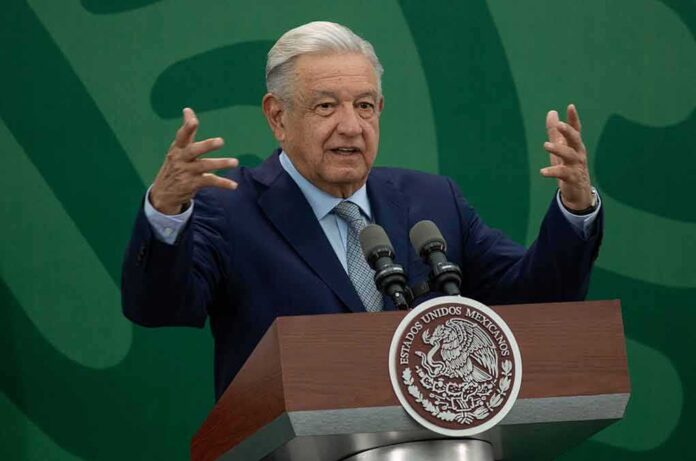
At least a dozen Mexican ruling-party officials quietly offered intelligence to U.S. authorities as President Trump’s crackdown on cartel-linked corruption expands.
Story Highlights
- New York Times reporting says multiple Mexican officials approached U.S. authorities to share intel on colleagues.
- Reports tie the contacts to Trump-era investigations into cartel corruption and political protection networks.
- Mexico’s president accuses the United States of meddling as indictments and probes advance.
- Past leaks to cartels show why the U.S. is cultivating insiders instead of relying only on formal channels.
Mexican Insiders Turn to U.S. Investigators
The New York Times reported that more than a dozen elected officials in Mexico, many from the ruling party, initiated or deepened contact with U.S. authorities to share intelligence on fellow politicians. The outreach followed stepped-up U.S. investigations into alleged cartel ties inside Mexican politics under President Trump. A YouTube segment summarizing the reporting said the officials’ moves created a crack within Mexico’s ruling party as probes gathered pace. These developments signal stress inside Mexico’s power circles.
Infobae, citing the Times, said members of the Morena party discreetly offered themselves as informants against other party members. That report aligns with accounts that several officials already held discussions with U.S. counterparts. The shift points to self-preservation and pressure from ongoing cases. It also suggests some insiders see U.S. channels as safer or more credible than their own institutions. That dynamic often follows fears of retaliation or skepticism about clean local prosecutions.
Why U.S. Authorities Are Working Around Formal Channels
Past cases show why U.S. agencies hedge against compromised channels. U.S. prosecutors previously alleged a Mexican police intelligence commander leaked a Drug Enforcement Administration probe to the Beltrán Leyva cartel for millions of dollars. Reuters reported that corrupt figures inside Mexico’s security agencies passed U.S. anti-drug intelligence to traffickers, helping them dodge raids. These breaches make quiet cultivation of vetted insiders attractive when formal cooperation is slow or unsafe. That approach is risky, but cartels exploit any gap.
Policy analysts have tracked the cycle for years. The Brookings Institution chronicled Mexico’s 2020 law that restricted foreign agents and forced officials to report every contact, which complicated joint work and slowed results. After those curbs, Washington emphasized measurable outcomes, like prosecuting politicians with cartel ties, to rebuild trust and momentum. A 2025 joint statement from the U.S. Department of State said both nations aimed to dismantle transnational crime through enhanced cooperation among law enforcement and courts. Results require dependable partners on both sides.
Pushback From Mexico’s Leadership and the Rising Stakes
Mexico’s president, Claudia Sheinbaum, has accused the United States of meddling and said her government has not seen evidence behind some allegations against officials, promising its own reviews. Politico reported similar pushback when indictments of current and former Mexican officials surfaced in the United States. These reactions fit a long pattern. One side frames intelligence-sharing as fighting cartels; the other calls it a sovereignty issue. That tension hardens when probes reach governors or party insiders.
For American readers, the stakes are direct. Cartel networks fuel fentanyl deaths, human smuggling, and violence that bleeds over the border. President Trump’s team is seeking concrete results, including cases that expose political protection rackets, not just kingpin headlines. Cultivating whistleblowers inside Mexico’s ruling circles could speed that work and protect Americans. But success depends on tight vetting, security for sources, and strong follow-through by U.S. courts. Cartels and corrupt officials will test every weak link.
What This Means for Border Security and U.S. Policy
U.S.–Mexico coordination has recently expanded in focused areas, including information-sharing on arms trafficking, extraditions, and even drone threats at the border, according to public readouts and news reports. Those efforts can cut cartel firepower and cash flow if partners are reliable. The new wave of Mexican informants, if credible and protected, could help map political pipelines that shield crime. That is how you move from raids to lasting change—by breaking the corrupt cover that keeps cartels safe.
Readers should expect more noise from Mexico City as cases move and more insiders flip. That is normal when entrenched interests feel heat. The goal for the United States is simple and constitutional: enforce our laws, secure our border, and protect American families. Trusted sources inside compromised systems are not a luxury; they are often the only path to the truth. If these informants help deliver clean cases, the result is fewer drugs, fewer deaths, and a safer homeland.
Sources:
theatlantic.com, facebook.com, youtube.com, voanews.com, nsarchive.gwu.edu, latimes.com, mexico.affairs.media, mexiconewsdaily.com, csis.org, state.gov
© standardnewsdaily.com 2026. All rights reserved.