
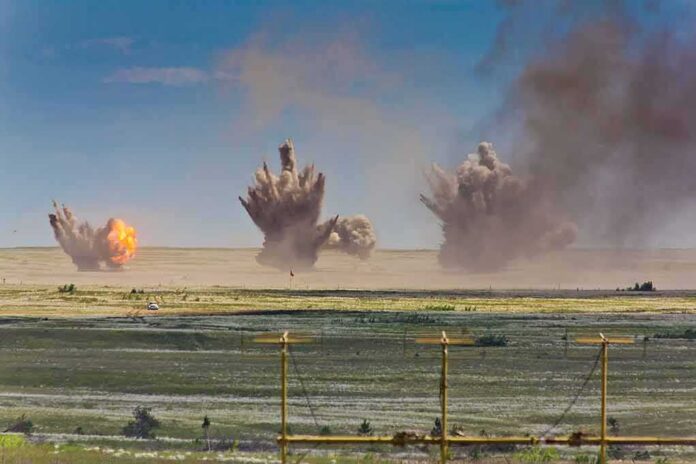
The Army blew up nearly five tons of degraded lead azide in Iowa after emergency approvals and court fights, raising urgent questions about how it ever got that dangerous.
Story Highlights
- The operation targeted 9,773.5 pounds of unstable lead azide stored in 68 drums.
- EPA granted emergency permits and later authorized controlled detonation; courts paused, then allowed it.
- EPA said initial air monitors showed zero detectable airborne lead after the blast.
- Environmental groups argue health risks and safer options were not fully vetted.
What Officials Did And Why It Mattered
Federal officials approved a controlled detonation of degraded lead azide at the Iowa Army Ammunition Plant after months of emergency handling. The plan covered about 9,773.5 pounds in 68 drums, a volume far above typical disposal jobs described in public records. The Army said the material had become too sensitive to move safely. The Environmental Protection Agency issued emergency permits and then a November 13 treatment authorization to allow detonation on site under strict conditions.
Environmental groups sued, saying the Environmental Protection Agency did not fully weigh health impacts or safer options. A federal appeals panel briefly paused the permit, and then a judge allowed the Army to proceed under the emergency authorization. The Army described tall sand barriers, a water wall, gel blocks, and foam to trap dust, along with air sensors on and off the site. Officials said weather rules and drone checks would guide the operation to reduce spread risk.
What Monitoring Found So Far And What We Still Do Not Know
The Environmental Protection Agency reported that one hour after the blast, real-time regional air monitors showed zero detectable airborne lead. That result addresses the most feared short-term air risk but does not close questions about soil, dust, water, or delayed exposure pathways. Before the detonation, the Environmental Protection Agency collected more than 1,200 baseline samples of air, land, and water to compare with post-blast results, and said remediation would start if needed. Final analyses and mapping of any deposits have not been released in full.
The Army’s public safety advisories said two-story sand barriers and water-based systems would dampen particles and capture debris. Officials said they used dispersion modeling to pick safe weather windows and set the design of the shields. Stationary monitors along the fence line and in nearby towns, plus mobile teams, were tasked to track the plume’s path and take surface wipes and soil samples for lab testing. Those steps align with the permit’s focus on dust control and rapid detection if spread occurred.
How A Stockpile Became An Emergency
The core dispute is stark. The Army says the stockpile became unstable and that delay raised the risk of a sudden explosion that could harm workers or neighbors. That framing led the Environmental Protection Agency to issue a string of emergency storage permits and then to authorize treatment in place. The Department of Justice warned that further delay could be more dangerous than a controlled blast under strict rules. Courts weighed these points when they lifted the administrative pause.
@DanaSammonsCarp @NewsTreason @Spaceshot76 @1776Tron
While America Was Watching: What Happened Outside the Headlines?An examination of public attention, government actions and the stories that deserve greater scrutiny.
Over the past several days, two narratives have occupied… pic.twitter.com/A3QFlBjbDb
— Brian Pfund (@13over6) November 27, 2026
Critics say the need for emergency permits shows a breakdown in oversight. They argue that the Environmental Protection Agency did not fully analyze human health, long-term environmental risks, or less dangerous options. They also point to the large number of baseline samples as proof that officials knew contamination pathways were possible and needed careful tracking. Their legal filings sought more time to test alternatives before any detonation.
Why This Case Hits A Nerve Across Politics
People across the spectrum see the same pattern. Agencies warn of an urgent threat and ask for trust. Communities hear that years of storage turned into an emergency with little public say. The volume here, nearly five tons, and the degraded, crystalized state made the choice starker than usual. Open detonation has long been used for unsafe munitions. But the scale, and the need to do it near homes and farms, tightened public concern about whether government stewards hazardous materials well.
The first-hour air readings calm one fear, but they do not finish the story. Lead can settle on soil and hard surfaces. It can move with dust and water. The Environmental Protection Agency’s pre-blast sampling gives a yardstick. What comes next are lab results on soil, surface dust, and water, plus any cleanup orders. Those facts will decide if the safeguards worked as planned, or if the community faces a longer chapter of testing and trust repair.
Accountability Questions To Watch
Key facts remain pending. Records could show whether inspections flagged rising risk early, and what options analysts compared before endorsing detonation. The full emergency permit file and monitoring data will help test claims from both sides. If final results show no meaningful spread, that supports the emergency plan. If they show hot spots, the focus will shift to why storage reached this point and whether a safer alternative was set aside too soon.
Sources:
epa.gov, weareiowa.com, d34w7g4gy10iej.cloudfront.net, agriculture.com, cbs2iowa.com, wqad.com, kimt.com
© standardnewsdaily.com 2026. All rights reserved.