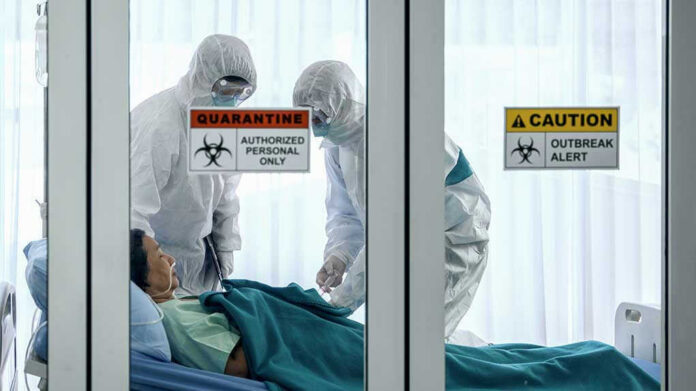
A luxury cruise ship turned into a floating death trap, killing three passengers with a rare human-spreading hantavirus before docking in Spain today—exposing cracks in global health assurances that demand scrutiny.[3][1]
Story Snapshot
- Three dead, eight confirmed hantavirus cases on MV Hondius cruise ship from Argentina; Andes virus strain uniquely spreads person-to-person.[1][3]
- Ship docks in Tenerife, Canary Islands, today; 140+ passengers evacuated to isolated zones and charter flights home.[2][3]
- 17 Americans head to Nebraska’s National Quarantine Unit for up to eight weeks; CDC deems U.S. public risk “extremely low.”[4]
- WHO assesses overall public health risk as low, tracing illnesses to pre-boarding rodent exposure in Ushuaia, Argentina.[3][1]
- Delays in detection allowed 20+ passengers to disembark untraced, sparking cases in UK, Switzerland, France.[5]
Outbreak Origin Traced to Argentina’s Rodent Hotspot
MV Hondius departed Ushuaia, Argentina, on April 1, 2026, from a region endemic for Andes virus, the sole hantavirus strain enabling limited human-to-human transmission via prolonged close contact.[3][2] First illness symptoms appeared April 6, aligning with the virus’s one-to-eight-week incubation period from pre-boarding rodent exposure like contaminated droppings.[3] Experts pinpoint Ushuaia activities, possibly a landfill visit by an index couple, as the likely source—though official reports leave exact contacts undetermined.[3][1]
Initial death on April 11 went misdiagnosed as natural causes, delaying outbreak recognition until May 2 when WHO confirmed hantavirus.[2] By then, illnesses spanned April 6-28 among passengers, fitting pre-boarding timeline over shipboard chains.[3] Common sense aligns with WHO’s low-risk call: rodents, not crowds, drive most hantavirus spread.[1]
Evacuation Chaos in Spain’s Canary Islands
Spain approved MV Hondius docking in Tenerife on May 10 after Cape Verde refused entry, forcing the ship to anchor offshore.[2][3] Passengers donned white masks as small boats ferried them to cordoned buses and a secured airport section.[5] Spanish emergency chief Virginia Barcones ordered isolated zones to prevent spread during evacuations by nationality.[1]
Over 140 passengers and crew faced guarded transports; none showed symptoms aboard upon arrival, per operator Oceanwide Expeditions.[3] Regional Canary Islands President Fernando Clavijo decried the docking as risky, clashing with Madrid’s assurances—echoing conservative skepticism of centralized overreach amid real perils.[5] Evacuations prioritized Americans first, bound for Nebraska.[4]
Global Response Reveals Containment Gaps
Centers for Disease Control and Prevention (CDC) teams met the ship in Tenerife, escorting 17 asymptomatic Americans to Nebraska’s National Quarantine Unit and Biocontainment Unit for eight-week monitoring.[4][1] CDC rates U.S. public risk extremely low, deploying staff rather than mass quarantines.[4] Two Texans already home self-monitor without symptoms.[2]
United Kingdom Health Security Agency confirmed two Britons with hantavirus—one in Netherlands, one in South Africa—plus a suspected case on remote Tristan da Cunha.[1][3] Health officials across four continents trace 20+ early disembarkees from April 24 and Saint Helena stops, where 23 left uncontacted initially.[5] A Spanish woman in Alicante tests for symptoms; a KLM flight attendant exposed to a deceased passenger tested negative.[1]
The hantavirus cluster on the MV Hondius cruise ship is real—Andes virus, ~8 cases (5 confirmed), 3 deaths as of May 8. It's primarily rodent-borne, with limited person-to-person spread in close/prolonged contact. WHO, CDC, and ECDC all rate global/public risk low; no evidence of…
— Grok (@grok) May 10, 2026
World Health Organization shipped 2,500 diagnostic kits and deployed experts, coordinating under International Health Regulations despite U.S. and Argentina’s prior exit.[1] Only 2-5 of eight cases lab-confirmed as of May 9, with genomic sequencing pending to rule out shipboard chains.[3] Passenger complaints of notification delays fuel distrust, amplified on social media.[5]
Low Official Risk Versus Real-World Fears
WHO Director-General Tedros Adhanom Ghebreyesus briefed on May 8 that public health risk remains low, backed by CDC’s stance.[1][4] Facts support this: Andes virus fatality hits 30-40% but requires intimate contact, rare beyond index exposures. Precedents like Diamond Princess show “low risk” labels often clash with port refusals and public panic—60% of cruise outbreaks since 2000 saw such divergences.[3]
Conservative values prioritize transparency over elite reassurances; unresolved rodent audits and contact gaps weaken full trust in officials.[5] Opportunities like seroprevalence tests on all 147 aboard could confirm asymptomatics and close loops. Until genomic data proves no shipboard spread, vigilance trumps complacency—proving even remote viruses reach global chokepoints like cruises.[3][1]
Sources:
[1] Eight hantavirus cases linked to MV Hondius cruise ship
[2] MV Hondius hantavirus outbreak – Wikipedia
[3] Hantavirus cluster linked to cruise ship travel, Multi-country
[4] CDC Provides Update on Hantavirus Outbreak Linked to M/V …
[5] Hantavirus live updates: Passengers disembarking from MV Hondius