The World Health Organization’s Ebola alert matters because it signals cross-border spread before the public has a stable grip on how big the outbreak really is.
Quick Take
- The World Health Organization declared the Ebola event in the Democratic Republic of the Congo and Uganda a Public Health Emergency of International Concern [2].
- The agency said international spread had already been documented, including confirmed cases in Kampala after travel from the Democratic Republic of the Congo [2].
- Reporting cited hundreds of suspected cases and dozens of deaths, but the totals varied across sources, showing that the data are still moving [1][3][5].
- Officials say the Bundibugyo strain has no approved drugs or vaccines, which leaves isolation, tracing, and monitoring as the main defenses [4].
WHO’s declaration and why it matters
The World Health Organization formally determined that Ebola disease caused by Bundibugyo virus in the Democratic Republic of the Congo and Uganda meets the legal threshold for a Public Health Emergency of International Concern, or PHEIC [2]. The agency also said the event does not meet the criteria for a pandemic emergency, which is an important distinction that gets lost when headlines flatten every serious outbreak into a generic global crisis [2].
WHO said the decision was based on information from the affected states, scientific principles, available evidence, and other relevant information [2]. That language shows the declaration was not made on rumor alone, but it also reflects a familiar problem in outbreak response: governments and health agencies must act while surveillance is incomplete. For readers, that means the alert should be taken seriously without assuming every early number is final.
What the outbreak looks like on the ground
WHO said international spread had already been documented, including two confirmed cases in Kampala, Uganda, on 15 and 16 May after travel from the Democratic Republic of the Congo [2]. Secondary reporting described an outbreak centered in eastern Congo, with suspected cases spread across multiple health zones and the possibility of larger transmission chains than the current count captures [1][3]. That is the kind of warning that usually appears when case finding is still catching up to reality.
STAT reported that the agency warned of “a potentially much larger outbreak than what is currently being detected and reported,” and said a three-week gap between an early suspected case and confirmation suggested a low clinical index of suspicion among health care workers [3]. That matters because weak detection can make an outbreak look smaller than it is. In places facing conflict, displacement, and strained hospitals, undercounting can become a public-health problem of its own.
Why response is harder than the headlines suggest
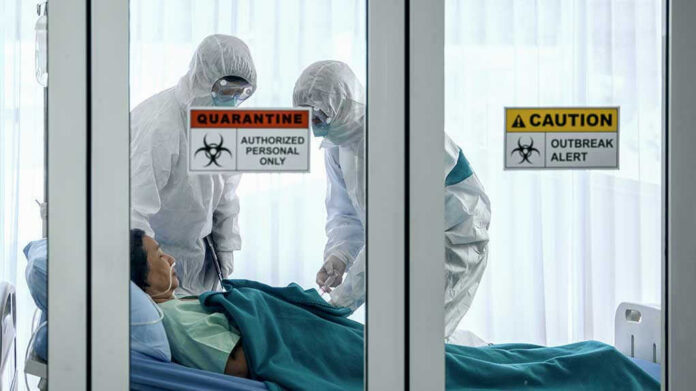
The current strain complicates the response because reporting says there are no approved drugs or vaccines for Bundibugyo virus [4]. That leaves isolation, contact monitoring, restricted travel for exposed contacts, and treatment-center care as the main tools [2][4]. WHO’s guidance is explicit on those points, which is why the declaration is less about symbolism than about forcing a faster operational response across borders, hospitals, and border checkpoints.
🚨 BREAKING: WHO declares Public Health Emergency of International Concern (PHEIC) over Ebola outbreak in DRC and Uganda.
246 suspected cases, 80+ deaths reported. Cross-border spread confirmed.
Full breakdown 👇 https://t.co/aU7bP5BlY3 #Ebola #WHO #PHEIC #PublicHealth— Shah (@MuhsinAbba61862) May 18, 2026
The public record in the supplied material still has limits. The sources give totals, locations, and a few travel-linked cases, but they do not provide a full patient-by-patient line list or complete laboratory record for every suspected infection [1][2][3][4]. Reporting also shows some mismatch in counts, with different outlets citing different numbers of suspected cases and deaths [1][4][5]. That does not erase the emergency, but it does show why early outbreak coverage should be read as provisional, not definitive.
What readers should watch next
The next question is whether health authorities can slow spread before the numbers rise further. The declaration itself is a sign that the risk is no longer confined to one area, and the Kampala cases show how quickly movement can carry disease across borders [2]. For a public already skeptical of institutions, this is another reminder that governments often react after the warning signs are visible, not before them. The test now is whether the response becomes coordinated fast enough to matter.
Sources:
[1] Web – WHO Declares Ebola Outbreak in Congo and Uganda a Global …
[2] Web – Epidemic of Ebola Disease caused by Bundibugyo virus in the …
[3] Web – WHO declares Ebola outbreak a global public health emergency
[4] YouTube – WHO declares global health emergency over the Ebola outbreak in …
[5] Web – WHO Declares ‘International Emergency’ Over Ebola in DR Congo …