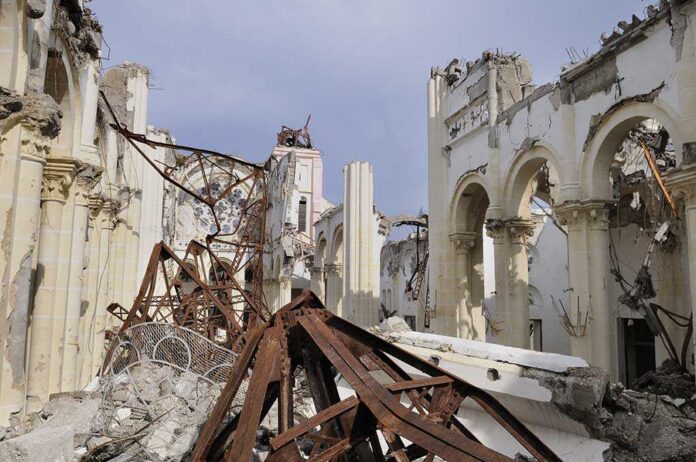
Europe’s official hate-crime monitors recorded hundreds of attacks on churches, clergy, and Christian sites last year, raising alarms across the political spectrum about safety, trust, and basic freedom of worship.
Story Highlights
- OSCE reports show significant anti-Christian incidents across France, Italy, Spain, and Austria, often vandalism, arson, and threats.
- France recorded that over one third of reported hate incidents targeted Christians, with many cases at churches and cemeteries.
- Jehovah’s Witnesses also faced threats and assaults, broadening the picture beyond Catholic targets.
- Totals vary by source and method, so a “Europe-wide surge” needs careful comparison and transparent data.
What the official record shows in multiple countries
Organization for Security and Co-operation in Europe data describe attacks on Christian sites and people in several nations. France’s 2024 submission notes that more than one third of recorded hate incidents were anti-Christian, with many cases of church and cemetery damage, theft of sacred items, and arson. Italy’s 2024 reporting includes property damage and assaults that targeted Catholic priests. Spain’s file records threats and intimidation against clergy and religious sites. Austria’s submissions document incidents across churches and community property.
These reports also show the targets are not uniform. Jehovah’s Witnesses reported threats, assaults, and damage to Kingdom Halls and literature carts, indicating a wider set of Christian communities under pressure. The pattern spans property crime and offenses against people. That mix matters for public safety planning and for how police classify cases. It also shapes how citizens read “rising numbers,” since vandalism and violence carry different risks and responses.
Why the totals are hard to compare across Europe
The Organization for Security and Co-operation in Europe’s Office for Democratic Institutions and Human Rights gathers both government and civil-society submissions, then analyzes them under a shared framework. The office warns that victims often do not report, and police do not always record bias, so the numbers are incomplete. Countries also differ in categories and coding. Spain’s national statistics do not use a specific “anti-Christian” category, which complicates cross-country comparisons and trend claims.
The Observatory on Intolerance and Discrimination against Christians in Europe has published European counts that mix official, Organization for Security and Co-operation in Europe, and its own research. The group says its headline 2,465 total for 2025 selects the highest figure per country rather than adding possibly overlapping sources, and it is separate from its 528 individually logged cases. That method avoids double counts but also means the sum is not a single, uniform dataset, so readers should be careful when claiming a “surge” across all of Europe.
What the pattern means for people of faith and civil order
Attacks on churches and threats against clergy do more than damage property. They shake confidence in basic freedoms and raise fear in local life. When priests are assaulted or churches are burned, older citizens see a country they no longer recognize, while younger families see fewer safe places to gather. That concern spans left and right because it touches security, dignity, and equal treatment under the law, not just theology or politics.
The Vienna-based Observatory on Intolerance and Discrimination against Christians in Europe (OIDAC Europe) identified 2,465 anti-Christian hate crimes and incidents in 2025, up from 2,211 in 2024.
Attacks on property, including churches and religious symbols, accounted for most… https://t.co/TmP9ck8sBi
— St. Testerical Ecilias (@stecilias) November 18, 2026
The path forward is practical. Authorities can separate counts of vandalism, threats, assaults, and arson to show real risk by type. Investigators can publish case outcomes, like arrests and prosecutions, to build trust. The Organization for Security and Co-operation in Europe urges regular, transparent releases and clear methods so citizens can see what changed and why. Civil-society groups can share incident-level registers, with dates, locations, targets, and verification notes, while protecting victims’ privacy.
How to read today’s headlines without false comfort or panic
Country reports confirm that anti-Christian incidents are real and present in many places, from France to Italy to Spain and Austria. Totals that blend different sources, categories, and methods tell us something is wrong, but not exactly how much worse it is from last year. Claims about causes, such as secularization or immigration, are political arguments unless linked to evidence in specific cases. Readers should demand clear data and steady enforcement, not excuses or spin.
Sources:
lifesitenews.com, hatecrime.osce.org, odihr.osce.org, 7676076fde29cb34e26d-759f611b127203e9f2a0021aa1b7da05.ssl.cf2.rackcdn.com, christianpost.com, intoleranceagainstchristians.eu, gospeller.org
© standardnewsdaily.com 2026. All rights reserved.