
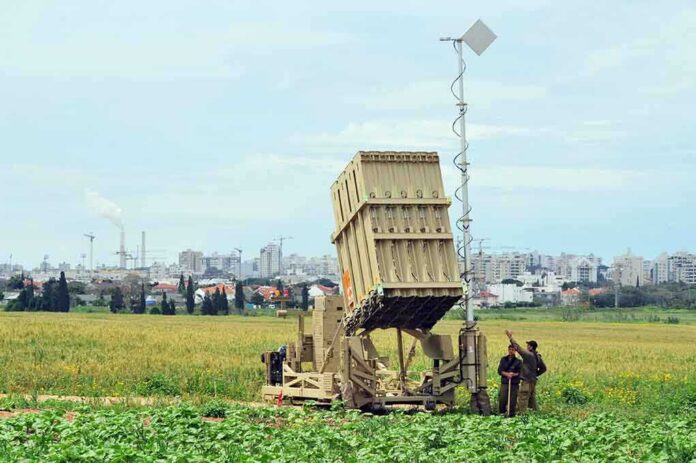
Autonomous mine-laying is not just another incremental upgrade; it fuses an old, brutally effective obstacle system with modern autonomy and data integration, shifting how armies deny terrain while reducing risk to the people who emplace those obstacles.
The Short Version
- The Army demonstrated an autonomous variant of the M139 Volcano that remotely fired and then emplaced two minefields without human intervention.
- The system mounts the legacy dispenser on a driverless Palletized Load System (PLS) truck and logs minefield locations to the common operating picture.
- Testing to date is Army-run and included inert canisters; independent safety, cybersecurity, and long-duration reliability data are not public.
- The capability addresses a real gap in rapid area denial while raising unresolved questions about verification, resilience, and legal-ethical use.
What the Army actually proved—and what it didn’t
In live-fire demonstrations at Camp Grayling, soldiers remotely fired the Autonomous Volcano and later tasked it to lay two distinct minefields without human assistance—an end-to-end autonomy run for a mission that historically exposes combat engineers to direct and indirect fire. The Army paired its decades-old M139 Volcano dispenser with a driverless PLS A1 truck and tied the emplacement process into the service’s common operating picture so mine locations are automatically recorded and shared. These are concrete, verifiable integration achievements: remote actuation of the dispenser, driverless mobility, and automated geospatial logging across the Army’s battle map architecture.
The capability matters because of scale and tempo. When vehicle-mounted, Volcano can blanket roughly 32 acres with up to 960 mines—a density and footprint that can shape avenues of approach, canalize forces, and buy time for maneuver or fires. Marrying that capacity to autonomy means fewer soldiers exposed on linear obstacle belts and faster, repeatable emplacement profiles when commanders need them most.
How the system works: dispenser, autonomy stack, and the data trail
The core of the system remains the M139 Volcano, a modular dispenser that fires canisters of scatterable mines in programmable patterns. Traditionally, soldiers drive predefined lanes and fire the system manually, tracking start/stop points and settings to estimate coverage. In the autonomous variant, a PLS A1 truck equipped with a By-Wire/Active Safety Kit executes a planned route, coordinates dispenser timing and canister sequencing, and publishes georeferenced emplacement data to the Army’s common operating picture. In practice, that turns an imprecise, human-noted obstacle into a digitally discoverable, sharable overlay, reducing blue-on-blue risk and improving post-conflict clearance planning.
Autonomy here is route-execution and actuation integration, not independent targeting. The truck follows a prescribed path; the dispenser fires per preloaded parameters; the system logs what it actually did, rather than what planners hoped it did. That feedback loop—a recorded, machine-generated trace—is the leap that allows commanders to tie obstacles to fire plans with more confidence, and to lift or bypass them later without guesswork.
What the demonstrations leave unanswered
Demonstrations validated autonomy and integration, not the full spectrum of wartime performance. The initial live-fire run used inert mine canisters; inert firings prove dispenser actuation and timings, but they do not validate live mine dispersal patterns, arming reliability, or dud rates within operational tolerances. Public records do not include a third-party safety audit, long-duration failure rate analysis, or cybersecurity validation of the autonomy stack—gaps that matter given electronic warfare, GPS degradation, and spoofing threats from capable adversaries. The event spanned three days of hands-on training, useful for proof-of-concept but insufficient to characterize reliability across weeks of vibration, dust, temperature swings, and maintenance cycles.
Absent, too, are data on performance in adverse weather—rain-slick clay, snow and ice, fog-obscured sensors—conditions that complicate traction, perception, and geolocation. The Army has indicated plans for more realistic battlefield scenarios; the significance of this capability will ultimately turn on those reports: route-keeping under jamming, dispenser reliability across full magazines, minefield geometry accuracy, and mean time between mission failure under sustained use.
Why autonomy for minefields is strategically consequential
Minefields shape battles by forcing an enemy to slow, bunch, or detour—moments when artillery, loitering munitions, and attack aviation are most lethal. Historically, laying those obstacles at scale required engineers to expose themselves along predictable lanes, often under observation. Autonomy decouples some of that exposure from the mission. It also standardizes execution: the same route and firing profile can be replicated night after night, and the machine will keep the log perfectly each time. In an era when counter-battery and drone reconnaissance compress the timeline between being seen and being struck, predictable, rapidly executed engineer tasks are an operational advantage.
Digitally recorded minefields also reduce fratricide and post-conflict harm. With precise logs, friendly forces can plan safe corridors; after hostilities, clearance teams can prioritize and measure progress against an authoritative digital baseline. This is not an ethical panacea—scatterable mines still pose grave risks—but it is a meaningful improvement over paper maps and human memory.
The legacy Volcano and its new autonomy: continuity and change
Volcano has been in service for decades as a truck- or helicopter-mounted scatterable mine system. Its value has always been rapid coverage over a large area with programmable patterns and self-destruct/self-deactivation features designed to reduce long-term hazard. The autonomous variant does not change the warhead; it modernizes the carriage and the command-and-control loop—placing the dispenser on a driverless platform and instrumenting the mission so data flows to the map in near-real time. That makes an old capability discoverable, schedulable, and accountable inside a modern kill chain, which is where most of the operational payoff resides.
The approach mirrors a broader trend: militaries worldwide are grafting autonomy onto legacy munitions and mission sets in mine warfare—on both the laying and countermeasure sides—because autonomy extends reach, persistence, and responsiveness without waiting for wholly new weapon families. The M139 upgrade is emblematic of this low-cost modernization vector, which favors integration discipline over exotic hardware.
Claims, counter-claims, and the evidence line
On the facts of the demonstration itself, there is little genuine dispute: the Army remotely fired the system and then had it autonomously emplace two minefields; senior engineers observed; and automated logging pushed data to the common operating picture. Those claims are supported by the Army’s own release and trade reporting and have not been met with specific, named, documentary refutation. That justifies confidence in the baseline: the integration works and can complete an autonomous route with dispenser actuation and data capture.
The strongest critiques are not refutations but unclosed loops: no independent safety metrics, no published cybersecurity hardening claims, inert-only public firings so far, and no adverse-weather or long-duration reliability trail. These are material caveats for a battlefield system. They do not erase the achievement; they define the work left to earn the word “ready.” Sensible next steps include third-party validation of route fidelity and emplacement accuracy, formal red-teaming against spoofing and jamming, and publication—at least at the summary level—of failure modes and effects analyses for the autonomy kit.
Operational prudence: how a commander should think about employment
Until independent data matures, an operational commander would treat Autonomous Volcano as a high-payoff, controlled-risk capability. Use it to extend obstacle belts where enemy reconnaissance and fires make manned emplacement prohibitive; select routes with robust PNT (position, navigation, and timing) alternatives and pre-briefed inertial dead-reckoning fallbacks; pair the mission with electronic protection measures; and require post-emplacement confirmation—via unmanned aerial reconnaissance or ground sensors—before committing the fires plan to the digital overlay alone. In other words, exploit autonomy’s strengths while insulating the scheme of maneuver from first-fielding surprises.
Legal and ethical guardrails: autonomy does not absolve responsibility
Scatterable mines are governed by international humanitarian law and, for many states, treaty obligations. The United States is not party to the Ottawa Treaty banning antipersonnel mines but observes the Amended Mines Protocol, which emphasizes self-deactivation features, detectability, and recording of minefields. The autonomous variant, by logging precise emplacement, arguably strengthens compliance with the obligations to mark and record. That is a legal improvement, not a moral endorsement. Ethical use still demands rigorous target discrimination at the command level—where to mine, when to arm, how long to persist—and credible measures for clearance and risk reduction after the fight. Autonomy changes the how, not the why or the duty of care.
What would constitute “proof” of readiness
Five data sets would convert this from promising milestone to fieldable workhorse. First, live-mine dispersal accuracy and activation rates across full magazines and representative terrains. Second, a statistically robust reliability profile for the By-Wire/Active Safety Kit under vibration, dust, precipitation, thermal extremes, and electromagnetic interference. Third, red-team cyber and EW assessments demonstrating resistance to GPS spoofing, datalink jamming, and command injection, with mitigations for degraded modes. Fourth, adverse-weather autonomy performance, including route-keeping on low-friction surfaces and perception under obscurants. Fifth, an independent audit—government lab or trusted FFRDC—of end-to-end mission safety, including abort logic and geofencing behavior.
Bottom line
The Army has credibly shown that a legacy, high-yield mine dispenser can be made autonomous, remotely fired, and tied into the modern battle map. That closes a real gap in rapid area denial while reducing risk to engineers. The achievement is integration, not speculation. Yet fielding confidence in contested environments will hinge on proof that goes beyond a three-day demo with inert canisters. Until the safety, cybersecurity, and long-duration reliability chapters are published—preferably by independent testers—this remains a strong prototype with clear operational promise and equally clear due diligence ahead.
Sources:
realcleardefense.com, defensenews.com, dvidshub.net
© standardnewsdaily.com 2026. All rights reserved.