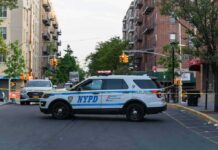
A routine ICE arrest in Los Angeles turned into a split-second deadly-force decision after a suspect allegedly used his car like a weapon.
Story Snapshot
- Federal agents say Carlitos Ricardo Parias, a 44-year-old Mexican national living in the U.S. illegally, rammed law-enforcement vehicles during a traffic stop in Los Angeles.
- Authorities say an ICE agent fired “defensive shots,” wounding Parias in the elbow; a deputy U.S. Marshal suffered a non-life-threatening hand injury from a ricochet.
- Parias, who reportedly ran a TikTok account covering immigration enforcement, faces a federal charge of assault on a federal officer and was expected in court Wednesday.
- The incident lands in a broader pattern: recent DHS shootings have frequently involved vehicles during immigration enforcement operations.
What authorities say happened during the Los Angeles stop
Federal officials say ICE agents, assisted by the U.S. Marshals Service, moved to arrest Carlitos Ricardo Parias during a Tuesday-morning traffic stop in Los Angeles using an administrative immigration warrant. Agents reportedly boxed in his vehicle to prevent escape. Authorities say Parias then rammed the vehicles in front of and behind him, and an agent attempted to break the driver’s-side window but could not gain control of him.
Officials say the confrontation escalated when Parias spun his tires and the car fishtailed, prompting an agent to fire rounds that struck Parias in the elbow. During the gunfire, a deputy U.S. Marshal was hit in the hand by a ricochet; authorities described the injury as non-life-threatening. Parias was taken into custody and, according to federal prosecutors, was scheduled for a court appearance the next day.
The legal and tactical question: when a car becomes a weapon
U.S. Attorney Bill Essayli emphasized a key point that appears repeatedly in these cases: vehicles can be treated as deadly weapons when used to strike officers or vehicles containing officers. That framing matters because it goes to the core of use-of-force standards—whether an officer reasonably feared serious bodily injury or death. Based on the reported ramming, the government argues the shooting was defensive, not punitive.
Even so, the limited public detail is a built-in constraint on outside analysis. The public has federal statements and some video reporting, but not a complete investigative file, full body-camera coverage, or a court-tested record of exactly how the vehicle moved in the seconds before shots were fired. That gap is why these incidents often become political flashpoints long before the legal process resolves disputed facts.
Why this case is drawing attention beyond the shooting itself
Authorities say Parias operated a TikTok account—“Richard Noticias LA”—where he posted as a citizen journalist focused on immigration enforcement. That detail changes how this story travels: it mixes enforcement, online activism, and real-world tactics on crowded city streets. In sanctuary jurisdictions like Los Angeles, where local policy limits cooperation with federal immigration enforcement, that public friction can sharpen distrust and increase the chances that routine arrests turn chaotic.
The bigger trend: vehicle encounters and a rising risk to the public
This Los Angeles incident also fits a broader pattern described in reporting on recent DHS-related shootings, many of which involved vehicles during enforcement actions. Separate Southern California incidents have included agents firing after alleged ramming, and at least one case involved a suspect fleeing after shots were fired. Critics argue aggressive tactics can raise the danger level in dense neighborhoods, while federal officials argue hesitation invites suspects to use cars to injure officers.
The political backdrop in 2026 makes this debate even sharper. Republicans hold the federal government and have prioritized immigration enforcement, while Democrats and activists frequently challenge tactics and sanctuary policies complicate coordination. For many voters—left and right—the uncomfortable throughline is institutional distrust: Americans see high-stakes enforcement carried out in public, then sorted out through statements, selective video, and litigation, leaving citizens to wonder whether government is protecting them or simply protecting itself.
Sources:
DHS: ICE agents shoot man who rammed their vehicle during L.A. stop
Criminal illegal immigrant rams car into ICE vehicle, agency says
Shooting incident involving border patrol agents reported in Willowbrook
Illegal migrant allegedly rammed law enforcement in California, with agent firing weapon, DHS says
Undocumented immigrant, officer hurt in shooting during targeted enforcement operation, DHS says