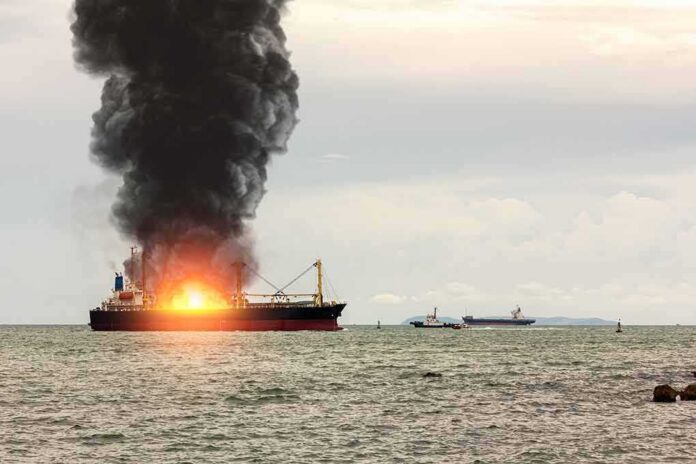
U.S. forces disabled a Curacao-flagged tanker near Iran’s Kharg Island after warnings, sharpening a risky game that could snarl oil flows and raise war costs for everyone.
Story Snapshot
- U.S. Central Command says it disabled the Belma as it moved toward Kharg Island after repeated warnings.
- Iran-linked officials say missiles struck a tanker at or near Kharg Island and claim it was hit again later.
- Major outlets describe a blockade enforcement action using a Hellfire missile to stop the vessel.
- Key facts like exact location, registry details, and damage reports remain thin in public view.
What CENTCOM Says Happened
United States Central Command said a U.S. aircraft fired a Hellfire missile to disable the Curacao-flagged tanker Belma as it headed toward Kharg Island. The command said the tanker was unladen and ignored multiple warnings to stop under the renewed U.S. blockade. The strike reportedly targeted the smokestack or engine area to halt propulsion and avoid sinking the ship. That account places the action in international waters and frames it as blockade enforcement, not a port strike.
Major outlets echoed that description. Reports from the British Broadcasting Corporation and Bloomberg said U.S. forces disabled the tanker after warnings and identified the vessel as Belma. Coverage said the ship was sanctioned and unladen, which would fit a run toward the oil hub without cargo. The emphasis on warnings and a disabling shot suggests a narrow goal: stop the voyage and send a message without major loss of life or a spill.
What Iran-Linked Sources Claim
Iran International, citing the deputy governor of Bushehr, said an empty tanker at or near Kharg Island was hit by U.S. missiles and identified the ship as Belma. Middle East Eye, quoting Fars via the same official, said the “Belma N.I.22” was attacked again two days after the first strike. Those claims suggest repeated hits and a location close to the island. They do not include registry numbers, photos, or a public damage survey to verify those details.
Reuters relayed that explosions were heard near Kharg Island, with semi-official Fars noting the origin was unknown at the time. That report captured confusion on the ground and showed how quickly wartime claims spread. It also highlighted a key gap: no independent forensic look at the hull, no insurance notice, and no tow log were available to confirm timing and exact location. These missing items limit firm conclusions beyond the strike itself.
Why This Matters for Energy, Law, and Trust
Kharg Island is Iran’s main oil export hub. Any armed action near it raises the chance of oil price spikes, insurance hikes, and disrupted tanker routes. Shipping companies will factor in higher risk premiums and may reroute or delay sailings. That raises costs that hit families through fuel and goods prices. Both sides know this. Each tries to shape the label: lawful blockade stop, or unlawful attack on a commercial tanker. Words here influence markets as much as missiles.
Reuters reports that an Iranian oil tanker near Kharg Island, Iran’s key oil-export hub, was reportedly struck by four U.S. missiles. No casualties were reported, and the crew was being evacuated. The U.S. has not yet officially confirmed the strike. #NationalSecurity
— The Dragoon (@CatholicDragoon) September 5, 2026
The record still has holes. Public sources do not show the vessel’s International Maritime Organization number, a verified ownership chain, or a class survey of the damage. Without those, details like “docked” versus “en route,” or “first” versus “second” strike, stay murky. The strongest confirmed element is the U.S. statement that it disabled an unladen Belma heading toward Kharg after multiple warnings. Everything else should be treated as claims awaiting independent checks.
How To Read The Competing Narratives
Wartime reporting often mixes facts with messages aimed at pressure and deterrence. The U.S. narrative stresses rules, warnings, and precision. The Iranian-linked narrative stresses harm and escalation. For citizens who feel elites hide the ball, the missing basics—photos, logs, surveys—feed doubt. The fix is sunlight: release registry records, satellite before-and-after images, and a neutral hull assessment. Clear evidence can cut through spin and help prevent a wider, costlier fight.
Sources:
npr.org, bbc.com, reuters.com, theguardian.com, nytimes.com
© standardnewsdaily.com 2026. All rights reserved.