
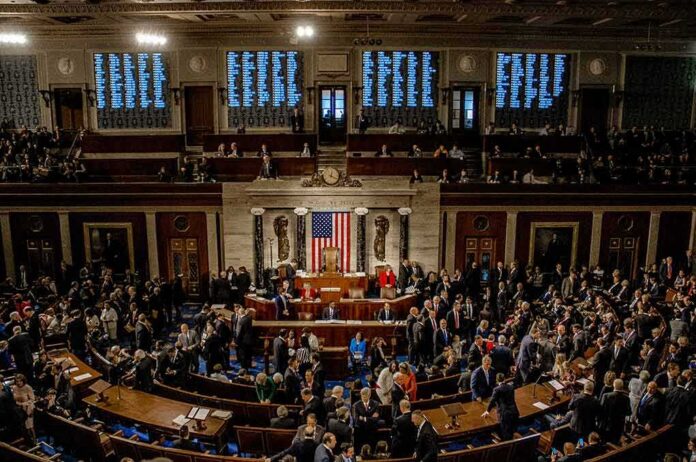
A Democratic sweep of Congress puts President Trump’s $1.5 trillion defense surge and Secretary Pete Hegseth’s agenda squarely in the crosshairs.
Story Highlights
- The administration filed a formal $1.5 trillion Fiscal Year 2027 defense request, the largest ever.
- Democrats vow aggressive oversight and signal opposition to the full topline and leadership.
- Congress can authorize programs but still must appropriate money, creating choke points.
- The plan’s $350 billion mandatory piece faces the steepest legislative hurdles.
What The Administration Proposed And Why It Matters
The Department of War said the Fiscal Year 2027 budget asks for a $1.5 trillion “generational investment,” about a 42 percent jump over current levels. Leaders framed the plan as rebuilding strength, supporting troops and families, modernizing gear, and expanding industrial capacity. Secretary Pete Hegseth said it fulfills President Trump’s pledge to secure American military dominance for decades. The request divides into $1.1 trillion in discretionary funds and $350 billion in mandatory funds.
Congressional analyses show clear line items inside the topline. The plan includes hundreds of billions for procurement and for research, development, test, and evaluation. That structure lets supporters defend specific weapons, readiness, and production goals even if Congress trims the total. Still, the split matters for process. Discretionary dollars ride annual appropriations. Mandatory funds would need separate legislation, likely through reconciliation, which is harder now.
How A Democratic Congress Changes The Battlefield
The Congressional Research Service reports that the House and Senate authorization drafts tracked close to the administration’s discretionary level. But authorization is not money in the bank. Appropriations write the checks, and Democrats now run the committees that decide what actually gets funded, when, and with what conditions. That gives them leverage to pare back, delay, or attach restrictions to operations and programs they oppose.
Democratic leaders signaled a tougher line on the budget and on Secretary Hegseth. Rep. Adam Smith pledged more intense oversight of the Pentagon and a probe of the administration’s defense budget. Analysts said a Democratic takeover would complicate passage of the $350 billion reconciliation plan. Party voices also argued they would not back a defense surge without matching nondefense increases, raising cost and deficit tradeoffs.
Targets: Topline Cuts, Guardrails On Operations, Leadership Pressure
Policy analyses describe Democrats rejecting the full $1.5 trillion request and preparing closer oversight of deployments, contracting, and spending transparency. Reporting also highlights pushes for hundreds of billions in reductions and new guardrails on military action in Iran. These levers could surface as hearings, subpoenas, conditions on funds, or revived oversight panels inside the Armed Services Committees. Each tool slows execution and reshapes priorities.
Senate Democrats were reported to be weighing Hegseth’s future and using funding timing as leverage. Party leaders and commentators floated ousting the secretary or, short of that, boxing in his policies through conditions in the annual bill. Such moves would aim to redirect strategy without a direct impeachment fight, while still asserting congressional control over war powers and spending. These plans, if pursued, would test separation of powers and chain-of-command stability.
What Conservatives Should Watch Next
Appropriations subcommittee drafts will show where the cuts land. Watch procurement and research lines that rebuild the defense industrial base and fix known gaps. If those are trimmed to fund unrelated agendas, our readiness suffers. Also track any broad “guardrails” on operations that read like micromanagement. Oversight should root out waste, not tie commanders’ hands mid-mission or trade away deterrence for short-term political wins.
Finally, keep an eye on the reconciliation path. The $350 billion mandatory piece was always the hardest lift. If Democrats block or demand large offsets and domestic add-ons, they can shrink or delay core programs for troops and production lines. The administration can still secure wins by locking in discrete systems and pay raises that command bipartisan support. The fight now moves line by line, where facts and delivery timelines beat slogans.
Sources:
congress.gov, war.gov, csis.org, abcnews.com, insidedefense.com, hklaw.com, yahoo.com, rollcall.com, thehill.com
© standardnewsdaily.com 2026. All rights reserved.