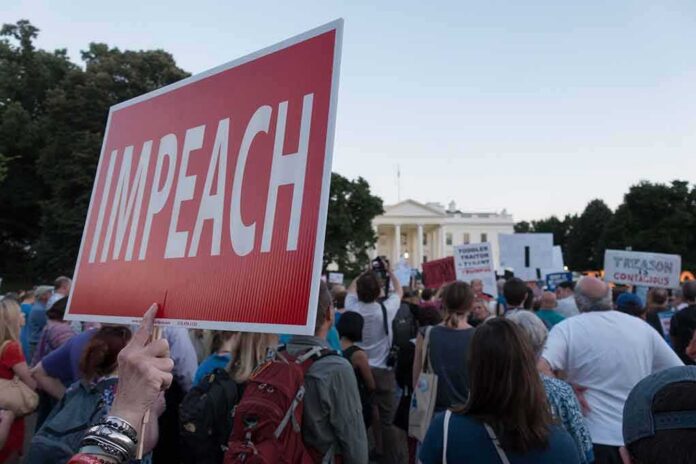
President Trump said impeachment talk “would destroy the Democrat Party,” as Democrats float charges that span years of election disputes and official conduct.
Story Snapshot
- Trump said he is “not at all” worried about impeachment after Democrats won Congress.
- House Resolution 1575 outlines broad election-related allegations against Trump.
- Democratic leaders frame any action as evidence-driven oversight, not revenge.
- Both sides invoke accountability, but offer different tests for proof and harm.
What Trump Said And Why It Matters
President Trump told the Washington Examiner on November 4 that he is “not at all” worried about impeachment. He argued Democrats would “destroy” their party if they tried. He also said the push would be “for no reason.” He made the comments after Democrats won majorities in the House and Senate in the 2026 midterms, which raised the odds of aggressive oversight. CNN and other outlets noted the remarks came amid talk of new inquiries by Democrats.
Trump also claimed the country is “more successful now than at any time in its history.” He did not share data to back that line in the cited coverage. Supporters see confidence and strength in the face of partisan heat. Critics say such claims dodge the substance. The clash sets up a now familiar pattern in Washington: one branch pushes oversight, the other calls it political. Voters, already skeptical of elites, see more gridlock instead of solutions.
What Is In The Draft Impeachment Article
House Resolution 1575, filed October 29, lists a wide range of alleged acts. It cites false claims about the 2020 election, pressure on election officials, and new doubts cast on the 2026 midterms. It also mentions demands about voter rolls and tying federal funds to election-related steps. The scope covers years of disputes, not just one recent event. That reach lets Trump say it is political, but it also gives Democrats a concrete bill to point to.
The breadth cuts both ways. It may help Democrats argue a pattern of conduct, rather than a one-off mistake. It may also let the White House argue the case is a catchall of old fights, repackaged. The record we have shows the filing exists and names categories of conduct. It does not tell us which facts are locked in, which claims are still under review, or what level of proof House managers would present if it advanced.
How Democrats Frame Accountability
Senator Elissa Slotkin says the standard is simple: if you break the law or abuse taxpayer money, you should face consequences, no matter your party. She adds that any probe should include officials who “enabled” wrongdoing, not just the president. That lens puts the focus on specific cases, contracts, and spending choices. Party strategists have also said impeachment would follow evidence, not lead it, if inquiries justify that step.
Democrats also pitch oversight as a deterrent. They argue clear consequences can stop future abuse by warning those who would cross lines. They cite alleged no-bid deals and questionable spending as examples they want to test. Supporters say this protects the public purse. Skeptics hear selective enforcement that targets opponents while allies skate. Both readings thrive when trust is low and details drip out over months, not days.
Why Timing Fuels The Backlash
History shows Congress turns up the heat when it opposes the White House. Studies of past decades link divided control to more investigations and more talk of impeachment. That does not prove any single charge is false. It does explain why each side sees politics at play. The base rate of fights rises when power splits, and today’s polarized media makes each move feel like total war to voters at home.
Democrats Seize Congress
Democrats have flipped the House and Senate in the midterm elections, securing at least 228 House seats and a 54–44 Senate majority. Vance attributed voter defections to the war, living costs, and U.S.–Israel ties. With Trump facing two years of divided… pic.twitter.com/i6uWDIFsYC
— Muhammet Ali Zurnacı (@malizurnaci) November 4, 2026
Many Americans across the spectrum view Washington as serving insiders first. They watch leaders trade quotes and threats while costs rise and problems stack up. If Democrats rush and miss, they risk proving Trump’s point about political payback. If they build a careful record and act only on strong evidence, they may win skeptics. If the White House wants to blunt the push, it can release records and data that answer each claim with facts, not just slogans.
Sources:
youtube.com, bloomberg.com, edition.cnn.com, washingtonexaminer.com, marketscreener.com, theatlantic.com, slotkin.senate.gov, onlinelibrary.wiley.com
© standardnewsdaily.com 2026. All rights reserved.