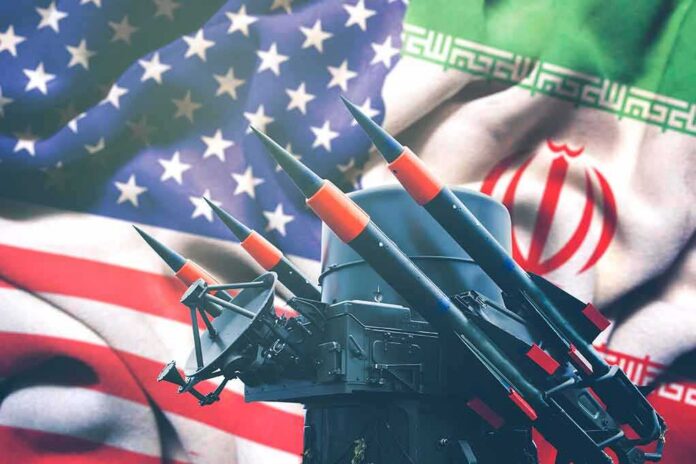
An Iranian missile and drone strike on a U.S. base in Jordan has killed two American service members and left one missing, putting the growing Iran war and Trump’s promise to protect our troops under a harsh spotlight.
Story Snapshot
- Two U.S. service members were killed in Jordan defending against Iranian missile and drone attacks, with one still missing.
- Four wounded Americans were evacuated to Jordanian hospitals and later discharged, while others with minor injuries returned to duty.
- This is the first U.S. combat fatality from Iran’s strikes since March, adding to a rising toll on American forces.
- The attack fits a wider pattern of Iranian attacks on U.S. bases in Jordan and the region, testing Trump-era resolve and air defenses.
CENTCOM Confirms Dead and Missing After Iranian Strike
U.S. Central Command said that on July 17, two American service members in Jordan were killed in action while U.S. and partner forces defended against Iranian ballistic missile and drone attacks. The same statement said one more service member is currently listed as missing in action, and search and recovery efforts are underway to find them. Central Command has not yet released the names of the fallen, saying they will wait at least 24 hours after notifying next of kin out of respect for the families.
The command also reported that four American service members were medically evacuated to Jordanian hospitals after the strike and have since been discharged. Other personnel who were checked for minor injuries have returned to duty, showing both the severity of the main blast and the resilience of the unit that was hit. Media reports, echoing the Central Command release, describe the incident as one of the deadliest single strikes on U.S. forces since the Iran war escalated earlier this year.
Rising Toll on U.S. Forces in Trump’s Iran War
This latest loss comes on top of earlier deaths from Iranian and Iran-backed attacks during the current conflict. A January 28, 2024 drone strike on the Tower 22 outpost in northeast Jordan killed three American soldiers and injured dozens more, with militants backed by Iran claiming responsibility while Tehran denied direct involvement. Since the Iran war flared in February 2026, news outlets now report that at least sixteen U.S. service members have been killed, including thirteen in the opening phase, one Navy pilot in a non‑hostile crash, and the two troops lost in Jordan on July 17.
Iran has openly targeted U.S. positions across the region as President Donald Trump ordered waves of strikes against Iranian military sites and infrastructure. Tehran’s Islamic Revolutionary Guard Corps has boasted of hitting American bases and assets in Jordan, Kuwait, and Bahrain with missiles and drones, framing these attacks as payback for U.S. operations near the Strait of Hormuz. Jordanian officials have admitted that large numbers of Iranian missiles and drones have crossed their airspace during this conflict, forcing the kingdom and U.S. forces to intercept attacks near key bases that host American troops.
Jordan Bases Under Fire and Air Defense Questions
Iran has repeatedly signaled that it wants to punish Jordan for hosting U.S. forces, focusing on areas like Al‑Azraq and the Muwaffaq Salti Air Base where American units operate. Analysts note that Jordan intercepted many incoming missiles in earlier waves, but some still landed and caused injuries and damage, underscoring the limits of even modern air defenses under sustained attack. Past deadly strikes, like the Tower 22 drone attack in 2024, already pushed Central Command to reassess air defense needs across the Middle East and consider how to better shield small forward bases from one‑way drones and ballistic missiles.
In this July 17 attack, Central Command has not yet released visual proof from radar or satellite feeds, but the pattern matches Iran’s recent use of mixed drone and missile salvos to overwhelm defenses. Viral videos online claim to show Iranian missiles slipping past U.S. Patriot batteries and hitting American positions, feeding fears that existing systems may not be enough against new Iranian tactics and technology. While some footage is likely edited or computer‑generated, the real‑world casualties in Jordan and elsewhere make clear that the threat is not virtual—it is deadly and ongoing for the men and women Trump has kept deployed in harm’s way.
Accountability, Strategy, and Conservative Concerns
For many conservative Americans, these deaths raise hard questions about mission, rules of engagement, and how far the United States should go in a war that Iran is using to test our strength. Trump has promised to make Iran “pay the price” for attacks and has reimposed measures like a naval blockade around Iranian ports, but every fallen soldier reminds families that the cost is not just measured in damaged bridges or fuel docks in the Gulf—it is measured in American lives. Supporters expect firm action that deters future strikes without sliding into endless war or inviting more attacks on exposed bases.
Two U.S. Service Members Killed, One Missing in Iranian Attack on the Muwaffaq Salti Jordanian Air Base
Two U.S. service members were killed, four were hospitalized, and one remains missing in action following an overnight Iranian ballistic missile and drone attack on the… https://t.co/7iCPNLf1dG pic.twitter.com/GM2Ypb21hH
— SubX.News® (@SubxNews) July 18, 2026
This incident also fits a familiar information battle. Iran has a history of pushing false claims about U.S. casualties, like a propaganda report that three American officers were killed in Kuwait, which Central Command flatly denied. At the same time, some independent channels rush out unconfirmed numbers after every strike, adding to confusion before the Pentagon can speak clearly. In Jordan, however, the core facts are now settled: two U.S. service members are dead, one is missing, and Iran’s missiles and drones are once again drawing American blood, demanding answers and resolve from a nation that values its warriors and its Constitution above the games of distant regimes.
Sources:
redstate.com, centcom.mil, cnn.com, war.gov, english.alarabiya.net, defenseone.com, iranpress.com, thehill.com, abcnews.go.com, kwsn.com, breakingdefense.com, en.wikipedia.org, reuters.com, arabcenterdc.org, aljazeera.com, jpost.com, cfr.org, fdd.org, youtube.com, washingtonpost.com
© standardnewsdaily.com 2026. All rights reserved.